
Introduction: Why Growth Hacking Matters in Today’s Business World
Every business—whether a startup, a small company, or even a large enterprise—has one goal in common: growth. But achieving rapid, sustainable, and cost-effective growth is often the biggest challenge. Traditional marketing methods such as print ads, billboards, and television commercials are expensive, slow, and sometimes ineffective What is Growth Hacking? Complete Guide.
That’s where growth hacking comes in. Born out of the startup culture in Silicon Valley, growth hacking has become one of the most effective ways to achieve rapid business expansion without huge budgets. Instead of relying on traditional marketing, growth hacking focuses on data-driven experiments, creative techniques, and unconventional strategies to achieve exponential growth.
In this complete guide to growth hacking, we’ll explore:
- What growth hacking really is
- How it differs from traditional marketing
- Core principles and strategies
- Proven case studies of companies that scaled using growth hacking
- Pros and cons
- Step-by-step process to implement growth hacking in your business
- Actionable insights you can apply today
H1: What is Growth Hacking?
Growth hacking is a marketing and product development strategy focused on rapid experimentation across various channels to identify the most effective ways to grow a business.
The term was first coined by Sean Ellis in 2010, who described a growth hacker as:
“A person whose true north is growth. Everything they do is scrutinized by its potential impact on scalable growth.”
Unlike traditional marketers, growth hackers don’t just run campaigns—they combine marketing, product development, engineering, and data analysis to create innovative growth solutions.
H2: Key Characteristics of Growth Hacking
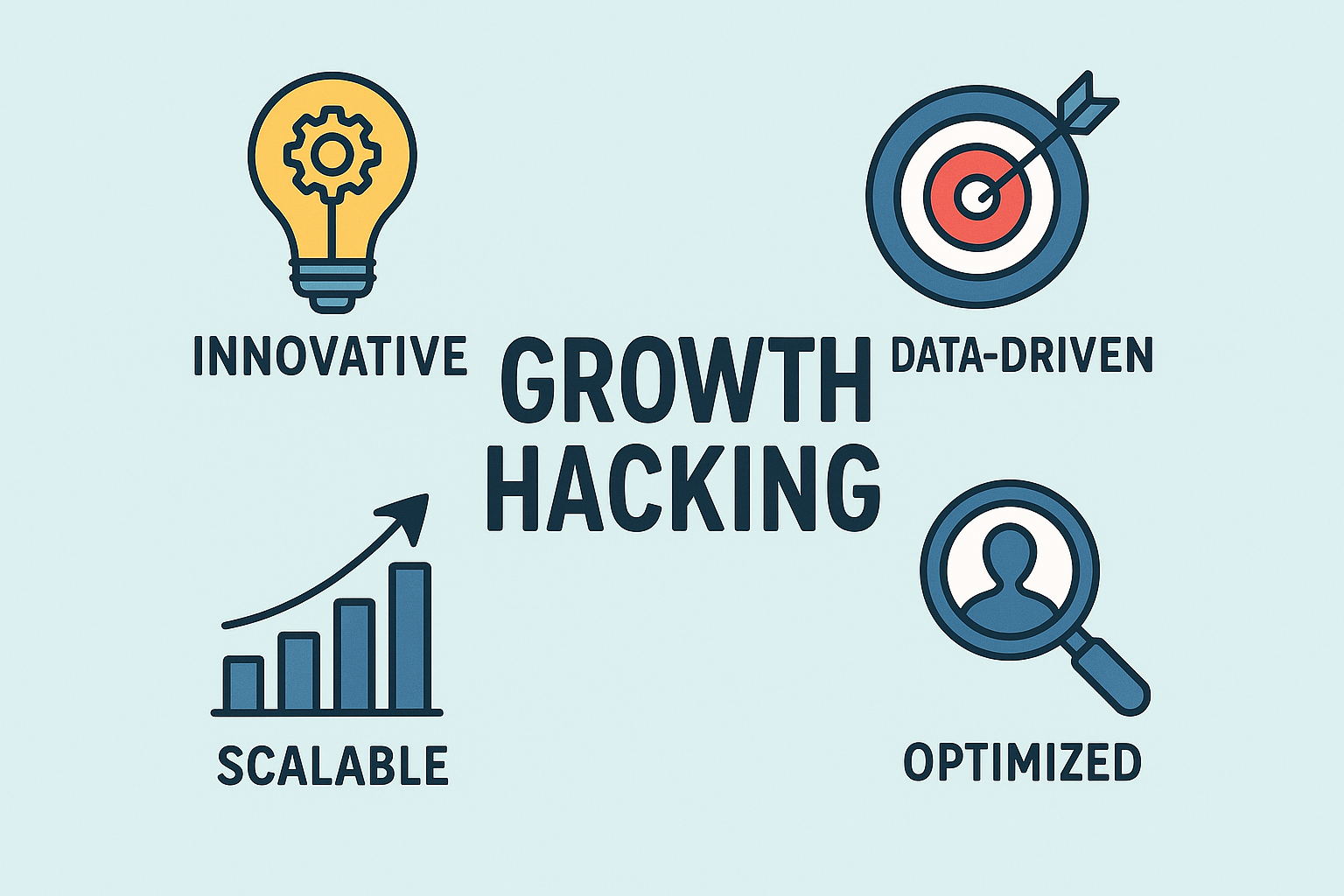
Growth hacking is different from conventional marketing in the following ways:
H3: 1. Data-Driven Decisions
Growth hackers rely heavily on data, analytics, and testing to guide decisions instead of assumptions.
H3: 2. Low-Cost, High-Impact Strategies
Instead of huge ad budgets, growth hacking uses creative, cost-effective techniques to achieve massive results.
H3: 3. Cross-Disciplinary Approach
It combines marketing, coding, analytics, design, and psychology to achieve growth.
H3: 4. Focus on Virality & Scalability
The goal is exponential growth, often through viral loops, referrals, and word-of-mouth marketing.
H2: Difference Between Growth Hacking and Traditional Marketing
| Aspect | Growth Hacking | Traditional Marketing |
|---|---|---|
| Goal | Rapid, scalable growth | Brand awareness & sales |
| Approach | Experiment-driven | Campaign-driven |
| Budget | Low-cost, resourceful | High-budget |
| Timeframe | Short-term rapid scaling | Long-term brand building |
| Team Skills | Cross-functional (tech + marketing) | Marketing-focused |
H2: Core Principles of Growth Hacking
Growth hacking revolves around certain principles that help businesses achieve exponential growth.
H3: 1. Product-Market Fit
If your product doesn’t solve a real problem for a real audience, no growth strategy will work.
H3: 2. Experimentation and Testing
Constant A/B testing, user feedback, and rapid experimentation are essential.
H3: 3. Scalability
Growth strategies must be able to handle 10x or 100x user growth without breaking.
H3: 4. Virality and Network Effects
Encouraging users to invite others naturally accelerates growth.
H3: 5. Retention over Acquisition
Keeping existing users engaged is often more cost-effective than acquiring new ones.
H2: Growth Hacking Funnel (AARRR Framework)
The AARRR framework, also known as the Pirate Metrics, is the backbone of growth hacking.
- Acquisition – How users find you (SEO, social media, ads).
- Activation – First user experience (sign-ups, onboarding).
- Retention – Keeping users engaged.
- Referral – Encouraging users to refer others.
- Revenue – Turning users into paying customers.
This funnel helps growth hackers identify bottlenecks and optimize for maximum results.
H2: Growth Hacking Strategies and Techniques
Let’s explore some proven growth hacking strategies businesses use to scale.
H3: 1. Content Marketing as a Growth Hack
- Blogging, SEO, and guest posting.
- Case Study: HubSpot used inbound marketing to dominate digital marketing education.
H3: 2. Viral Referral Programs
- Dropbox grew from 100,000 users to 4 million users in 15 months by offering extra storage space for referrals.
H3: 3. Product-Led Growth (PLG)
- Offering free tools or freemium models.
- Example: Grammarly and Slack used PLG to acquire millions of users.
H3: 4. Leveraging Social Media Trends
- Engaging on TikTok, Instagram Reels, and Twitter with trending content.
- Example: Gymshark built a billion-dollar brand through influencer marketing.
H3: 5. Email Marketing Automation
- Personalized onboarding and engagement emails keep users active.
H3: 6. SEO & Organic Growth
- Long-tail keywords and high-quality blogs generate consistent traffic.
H3: 7. Gamification
- Adding rewards, points, or badges to boost engagement.
- Example: Duolingo used gamification to become the #1 language-learning app.
H2: Real-Life Case Studies of Growth Hacking
H3: Dropbox
- Growth hack: Referral program offering extra storage.
- Result: Grew to millions of users at almost zero ad spend.
H3: Airbnb
- Growth hack: Leveraged Craigslist listings to redirect users to Airbnb.
- Result: Massive boost in user base with minimal marketing.
H3: Hotmail
- Growth hack: Added “PS: I love you. Get your free email at Hotmail” at the bottom of every email.
- Result: 12 million users in 18 months.
H3: LinkedIn
- Growth hack: Public user profiles appeared on Google search.
- Result: Millions of users discovered LinkedIn profiles organically.
H2: Pros and Cons of Growth Hacking
H3: Pros
- Cost-effective
- Rapid results
- Encourages innovation
- Focused on measurable growth
H3: Cons
- Not sustainable long-term if poorly executed
- Can be risky (requires constant testing)
- May overlook brand building in favor of quick wins
H2: How to Implement Growth Hacking in Your Business
H3: Step 1 – Define Clear Goals
Set measurable KPIs like monthly active users, revenue, or sign-ups.
H3: Step 2 – Know Your Audience
Create buyer personas to understand pain points.
H3: Step 3 – Build a Growth Team
Include marketers, developers, data analysts, and designers.
H3: Step 4 – Experiment and Test
Run A/B tests on landing pages, pricing models, and emails.
H3: Step 5 – Measure and Scale
Double down on strategies that work; drop the ones that don’t.
H2: Statistics that Prove Growth Hacking Works
- Dropbox: 60% user growth via referrals.
- Airbnb: Over 150 million users due to Craigslist growth hack.
- Slack: Grew to 8 million daily users in 5 years through word-of-mouth.
- Hotmail: Acquired 12 million users in 18 months.
H2: Actionable Growth Hacking Tips for Businesses
- Optimize landing pages for conversions.
- Use exit-intent popups to capture leads.
- Offer freemium trials to encourage adoption.
- Automate email sequences for onboarding.
- Leverage user-generated content for credibility.
- Encourage social sharing with incentives.
H2: Conclusion
Growth hacking is not just a buzzword—it’s a proven framework that has helped startups and global brands achieve explosive growth without relying solely on large budgets. By focusing on data-driven experimentation, scalability, and creative marketing tactics, businesses can unlock growth opportunities that traditional methods often miss.
Whether you’re a startup founder, marketer, or entrepreneur, adopting a growth hacking mindset can help you achieve rapid and sustainable growth in today’s competitive digital landscape.
H2: Frequently Asked Questions (FAQs)
H3: 1. What is growth hacking in simple words?
Growth hacking is a strategy that uses creative, low-cost marketing techniques and rapid experimentation to grow a business quickly.
H3: 2. Who invented growth hacking?
The term “growth hacking” was coined by Sean Ellis in 2010.
H3: 3. What is an example of growth hacking?
Dropbox’s referral program is a famous example where users got extra storage space for inviting friends.
H3: 4. Is growth hacking only for startups?
No, while it started in startups, many large companies like Airbnb, LinkedIn, and Slack use growth hacking principles.
H3: 5. How do I start growth hacking my business?
Start with clear goals, build a cross-functional growth team, experiment with low-cost strategies, and double down on what works.
What is Growth Hacking? Complete Guide What is Growth Hacking? Complete Guide What is Growth Hacking? Complete Guide What is Growth Hacking? Complete Guide What is Growth Hacking? Complete Guide What is Growth Hacking? Complete Guide What is Growth Hacking? Complete Guide What is Growth Hacking? Complete Guide What is Growth Hacking? Complete Guide What is Growth Hacking? Complete Guide What is Growth Hacking? Complete Guide What is Growth Hacking? Complete Guide What is Growth Hacking? Complete Guide What is Growth Hacking? Complete GuideWhat is Growth Hacking? Complete Guide What is Growth Hacking? Complete Guide What is Growth Hacking? Complete Guide What is Growth Hacking? Complete Guide What is Growth Hacking? Complete Guide What is Growth Hacking? Complete Guide