
Introduction
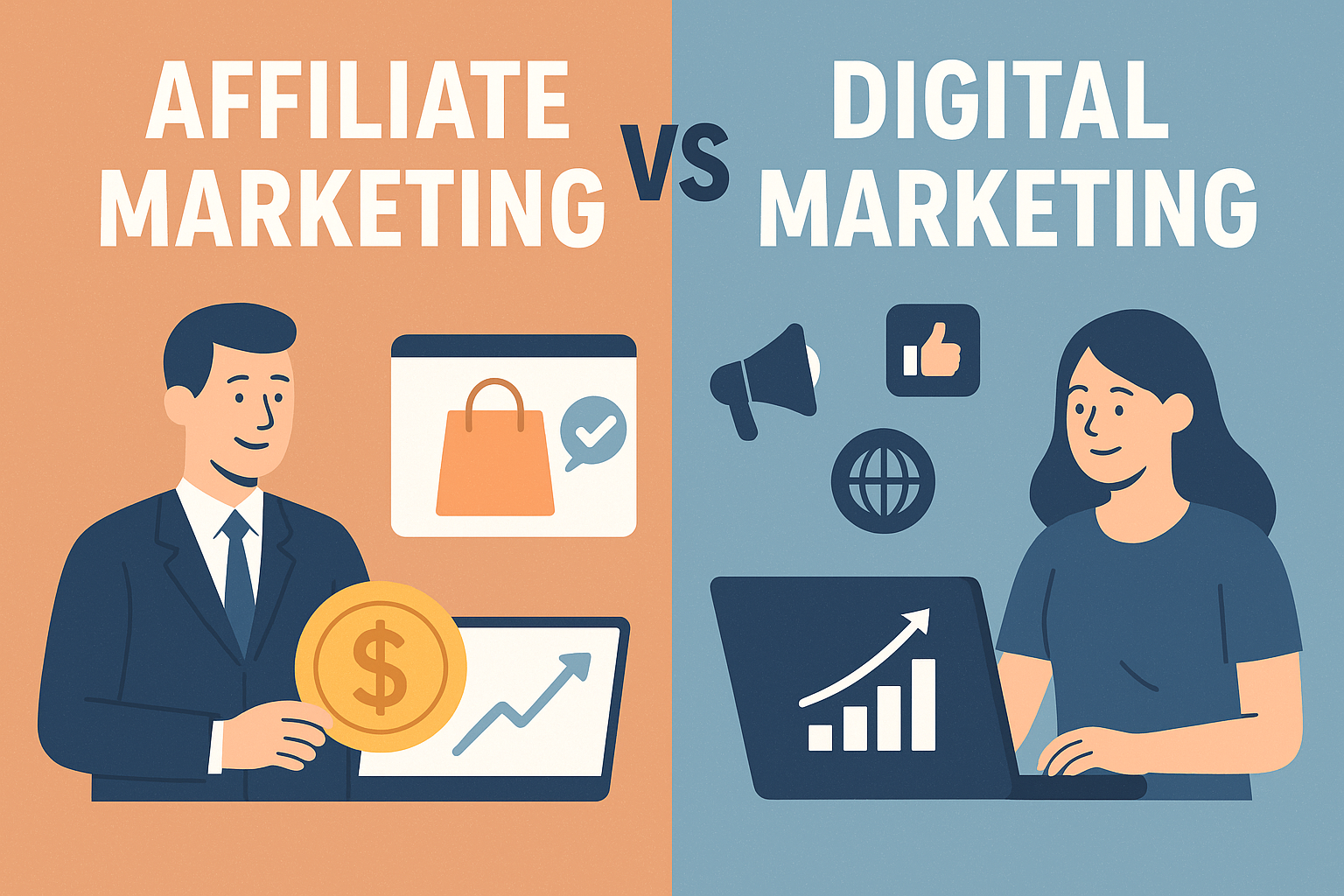
In today’s digital age, businesses and individuals have countless opportunities to earn money online and promote products effectively. Two of the most popular approaches are Affiliate Marketing and Digital Marketing Affiliate Marketing vs Digital Marketing Better?
But here’s the million-dollar question: Affiliate Marketing vs Digital Marketing – which one is better?
The answer isn’t as simple as one being universally better than the other. It depends on your goals, skills, investment, and long-term vision. In this in-depth guide, we’ll explore both concepts, highlight their differences, real-world use cases, pros and cons, and ultimately help you decide which path aligns better with your aspirations.
What is Affiliate Marketing?

Affiliate marketing is a performance-based business model where individuals (affiliates) promote products or services of other companies and earn a commission for every sale, lead, or click generated through their unique affiliate link.
In simple words, affiliates act as middlemen between companies and customers.
Example:
Suppose you join Amazon’s Affiliate Program. You write a blog about “Best Laptops for Students,” and insert affiliate links. When a reader clicks and buys a laptop through your link, you earn a commission.
Key Features of Affiliate Marketing
- No product creation required – You don’t need your own product.
- Low investment – Minimal startup cost compared to launching a brand.
- Performance-based – You earn only when someone buys through your link.
- Passive income potential – Evergreen blogs, YouTube videos, or reviews can generate income for years.
What is Digital Marketing?
Digital marketing is a broad umbrella term that covers all strategies businesses use to promote their products or services online. It involves building brand awareness, generating leads, and driving sales using digital platforms.
Common Digital Marketing Channels
- Search Engine Optimization (SEO)
- Social Media Marketing (Facebook, Instagram, LinkedIn, TikTok)
- Email Marketing
- Pay-Per-Click Advertising (Google Ads, Facebook Ads)
- Content Marketing (blogs, videos, infographics)
- Influencer Marketing
Example:
A clothing brand uses Instagram ads, influencer campaigns, and email newsletters to reach its target audience. This is digital marketing at work.
Affiliate Marketing vs Digital Marketing: The Core Differences
| Factor | Affiliate Marketing | Digital Marketing |
|---|---|---|
| Definition | Promoting other companies’ products for commission | Broad strategy to market one’s own product/service |
| Ownership | No product ownership | Own product/service required |
| Investment | Very low (website, blog, or YouTube channel) | High (ads, tools, branding) |
| Risk | Low risk | High risk (investment may fail) |
| Earning Model | Commission-based | Revenue from own sales/services |
| Scalability | Dependent on partnerships | Unlimited scalability |
| Control | Limited (rules set by companies) | Full control over campaigns |
Pros and Cons of Affiliate Marketing
✅ Advantages of Affiliate Marketing
- Low startup cost – Just need a blog, social channel, or website.
- No product handling – No worries about inventory, shipping, or customer support.
- Flexible working – Can be done from anywhere.
- Multiple income streams – Promote different niches and brands.
- Passive income – Old content can generate sales for months/years.
❌ Disadvantages of Affiliate Marketing
- Dependency – Relies on third-party companies. If they shut down programs, you lose income.
- Commission cuts – Brands can reduce commission rates anytime.
- High competition – Many affiliates promote the same products.
- Slow income growth – Requires patience and consistent content creation.
- Limited control – Rules of affiliate programs may restrict your promotion style.
Pros and Cons of Digital Marketing
✅ Advantages of Digital Marketing
- Full control – You own the brand and customer data.
- Scalable – Can expand globally with the right strategies.
- Multiple strategies – SEO, social media, paid ads, email marketing.
- Stronger brand building – Creates long-term brand loyalty.
- Higher profit margins – Since you own the product, revenue is direct.
❌ Disadvantages of Digital Marketing
- Higher cost – Requires investment in tools, ads, and staff.
- Steeper learning curve – Requires skills in SEO, ads, content, analytics.
- Time-consuming – Building a brand presence takes time.
- Higher risk – Poorly planned campaigns may lead to losses.
- Ongoing management – Needs consistent monitoring and optimization.
Real-Life Case Studies
Case Study 1: Affiliate Marketing Success
Pat Flynn, a well-known online entrepreneur, built a passive income empire through affiliate marketing. By blogging and creating tutorials, he promoted tools like Bluehost and earned over $100,000 monthly in affiliate commissions.
Case Study 2: Digital Marketing Success
Nike uses digital marketing campaigns to connect with its audience. Through influencer partnerships, social media ads, and storytelling, Nike maintains global dominance. Their 2022 campaign increased online sales by over 35% through targeted Facebook ads.
These examples show how affiliate marketing works best for individual entrepreneurs, while digital marketing shines for established businesses.
Affiliate Marketing vs Digital Marketing: Which One Makes More Money?
- Affiliate Marketing Income Potential:
Beginners may earn $100–$500/month after 6–12 months. Advanced affiliates earn $10,000+ monthly with high-traffic blogs, YouTube channels, or email lists. - Digital Marketing Income Potential:
Businesses can generate millions if strategies work. Freelancers and agencies also earn big by managing digital campaigns.
👉 If you want passive income with minimal risk, affiliate marketing is ideal.
👉 If you want to build a scalable business and brand, digital marketing is better.
When to Choose Affiliate Marketing?
- If you have low investment but want to earn online.
- If you enjoy content creation (blogs, videos, reviews).
- If you prefer passive income rather than active service.
- If you don’t want to handle products or customer support.
When to Choose Digital Marketing?
- If you own a business or startup.
- If you want full control over branding.
- If you have capital to invest in ads and tools.
- If you want long-term scalability.
- If you enjoy data-driven strategies and optimization.
Future of Affiliate Marketing vs Digital Marketing
- Affiliate Marketing Future:
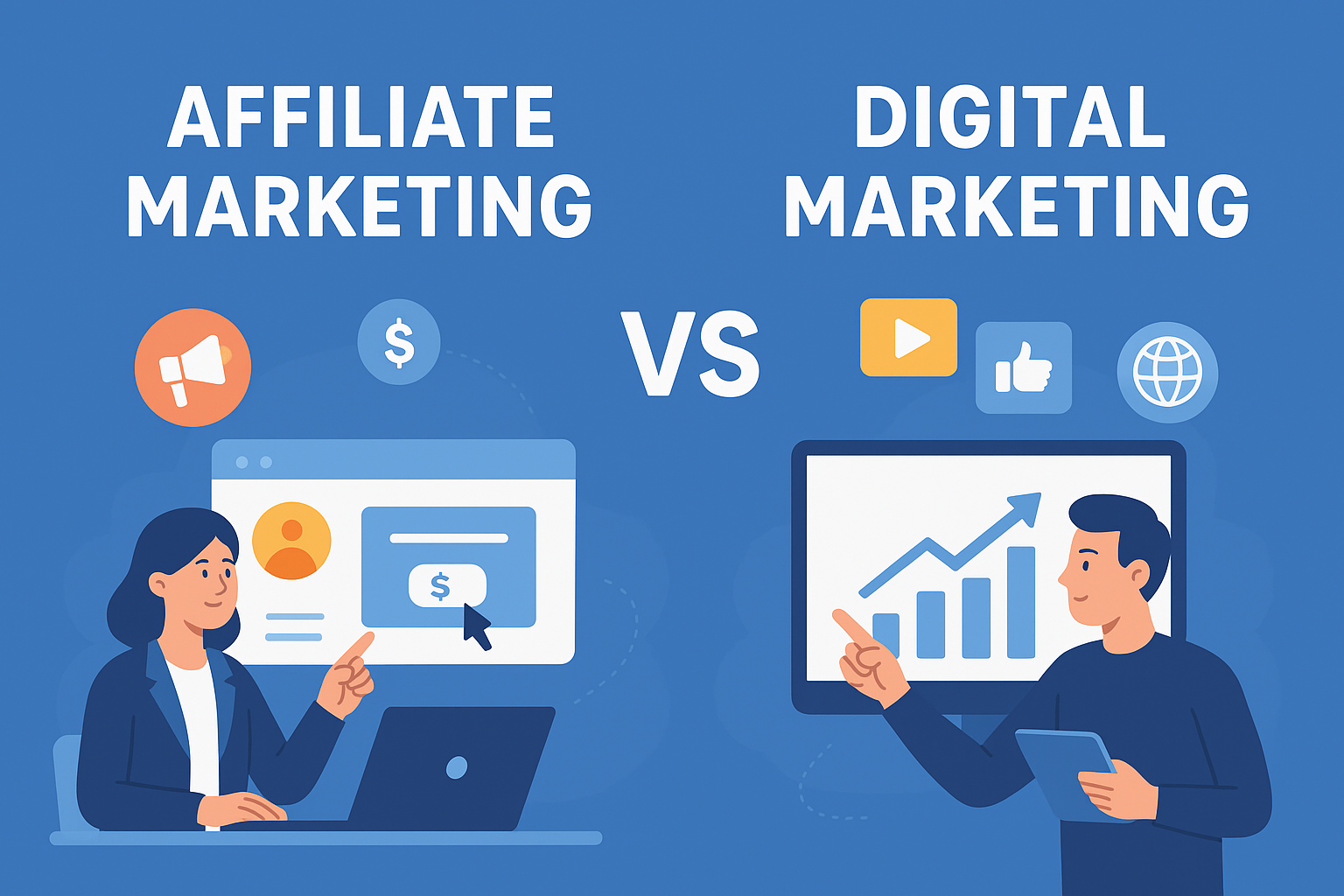
Expected to grow to $15.7 billion by 2027 (Statista). Content creators, influencers, and bloggers will keep benefiting from this low-entry business model. - Digital Marketing Future:
By 2030, the global digital marketing industry may surpass $1 trillion. With AI, automation, and personalization, businesses will rely heavily on advanced digital strategies.
Both industries have promising futures. The choice depends on whether you want to be an independent affiliate or a brand owner leveraging digital marketing.
Conclusion
Both Affiliate Marketing and Digital Marketing are powerful ways to earn and grow online.
- Affiliate Marketing is perfect for beginners, content creators, and those seeking low-cost passive income opportunities.
- Digital Marketing is ideal for entrepreneurs, businesses, and professionals looking to build long-term, scalable brands.
So, the right choice depends on your goals, skills, investment capacity, and risk appetite.
👉 If you want freedom, flexibility, and passive income, go with Affiliate Marketing.
👉 If you want scalability, control, and long-term business growth, choose Digital Marketing.
FAQs (Optimized for SEO)
1. Is affiliate marketing better than digital marketing?
Affiliate marketing is better for beginners with low investment, while digital marketing is better for businesses wanting long-term growth and brand control.
2. Can affiliate marketing make me rich?
Yes, but it takes time and effort. Top affiliates earn six to seven figures annually, but beginners should expect gradual growth.
3. Which is more profitable: affiliate marketing or digital marketing?
Digital marketing can be more profitable for businesses since they own the product. Affiliate marketing offers steady commissions but usually has smaller margins.
4. Do I need digital marketing skills for affiliate marketing?
Yes, basic digital marketing skills like SEO, social media marketing, and email marketing are helpful for promoting affiliate products effectively.
5. Which is easier to start: affiliate marketing or digital marketing?
Affiliate marketing is easier and cheaper to start since you don’t need your own product. Digital marketing requires more investment and strategic planning.
Affiliate Marketing vs Digital Marketing Better? Affiliate Marketing vs Digital Marketing Better? Affiliate Marketing vs Digital Marketing Better? Affiliate Marketing vs Digital Marketing Better? Affiliate Marketing vs Digital Marketing Better? Affiliate Marketing vs Digital Marketing Better? Affiliate Marketing vs Digital Marketing Better? Affiliate Marketing vs Digital Marketing Better? Affiliate Marketing vs Digital Marketing Better? Affiliate Marketing vs Digital Marketing Better? Affiliate Marketing vs Digital Marketing Better? Affiliate Marketing vs Digital Marketing Better? Affiliate Marketing vs Digital Marketing Better?Affiliate Marketing vs Digital Marketing Better?