

H1: What Is Digital Dopamine?
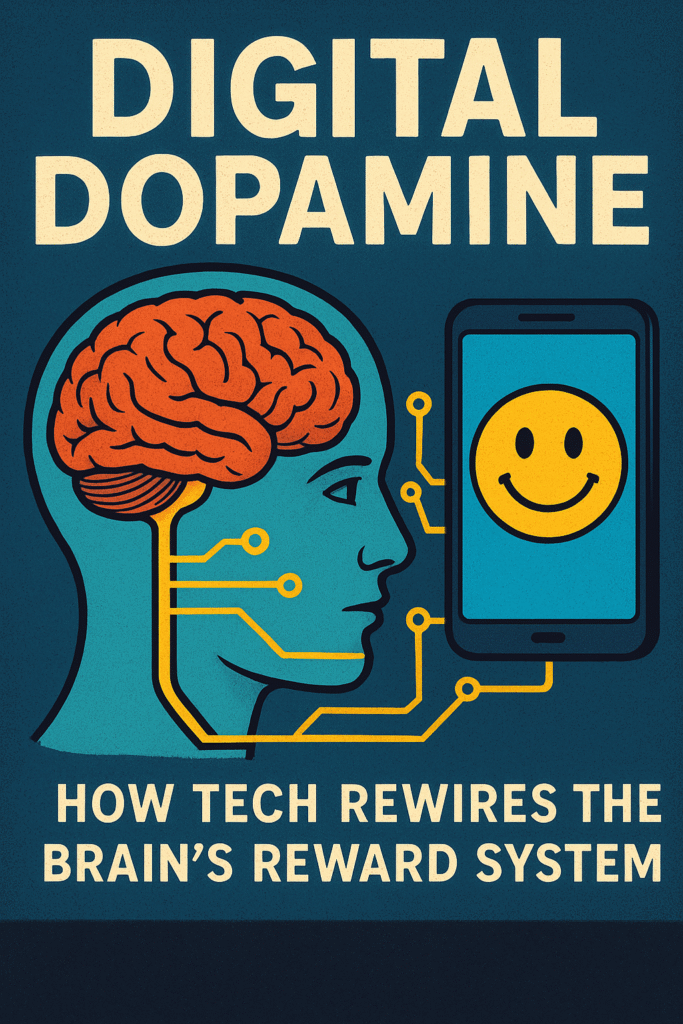
In today’s hyper-connected world, our screens are not just tools — they are gateways to constant stimulation. The term “Digital Dopamine” Digital Dopamine How Tech Rewires the Brains describes how digital platforms — like social media, mobile games, and notifications — hijack the brain’s dopamine-driven reward system to keep users engaged.
Dopamine is a neurotransmitter, often called the “feel-good chemical”, that motivates us to seek pleasure and rewards. Every time you receive a like on your photo, a new message, or a notification, your brain releases a small dose of dopamine. Over time, this constant stimulation can create habit loops — leading to compulsive scrolling, endless checking, and emotional dependency on digital validation.
H2: The Neuroscience Behind Dopamine and Technology
To understand digital dopamine, we must first understand how dopamine functions in the brain.
Unlike popular belief, dopamine isn’t just about pleasure — it’s about anticipation and motivation.
When you expect something rewarding — like opening your favorite app or seeing new likes — your brain’s mesolimbic pathway (the reward circuit) activates. This circuit involves the ventral tegmental area (VTA) and the nucleus accumbens, which are key dopamine centers.
Digital platforms have mastered this mechanism. Each notification or update acts as a “dopamine trigger.” Because the timing and content of rewards are unpredictable — similar to a slot machine — users develop reinforcement loops, constantly seeking the next hit of digital excitement.
H3: How Social Media Platforms Exploit the Dopamine Loop
Major tech companies design apps with behavioral psychology at their core. They use algorithms and UX patterns to maximize engagement and time spent on screen.
1. Variable Rewards System
Apps like Instagram, TikTok, and YouTube employ a variable reward mechanism — where users never know what they’ll see next. This unpredictability boosts dopamine release, similar to gambling machines.
2. Likes, Comments, and Shares
Social validation is a primal human need. Each notification triggers a sense of reward, activating dopamine pathways. Over time, users subconsciously crave more engagement to feel validated.
3. Endless Scrolling & Auto-Play
Infinite scrolling removes stopping cues, making it easy to lose track of time. Platforms like TikTok and YouTube Shorts auto-play content, delivering instant gratification — and reinforcing the dopamine cycle.
4. Notification Design
Red notification dots are no accident — they are intentionally designed using color psychology. Red stimulates urgency and attention, increasing the likelihood of opening the app.
H3: Real-Life Example – The TikTok Dopamine Trap
TikTok’s algorithm is one of the most advanced dopamine systems ever created. It tracks watch time, engagement, and reaction speed to predict what content will hold your attention next.
According to a Wall Street Journal investigation, TikTok can determine your interests in less than 40 minutes of viewing time. Each swipe releases a dopamine burst as your brain rewards the discovery of novel and personalized content. This creates a cycle of anticipation, gratification, and craving, which keeps users hooked for hours.
A 2024 study from Statista found that the average TikTok user spends 95 minutes daily on the app — a clear sign of the platform’s dopamine-driven design.
H2: The Psychology Behind Likes, Shares, and Validation
Humans are inherently social beings. From an evolutionary perspective, belonging to a group increased our chances of survival. Today, this social need is mirrored in digital spaces.
Each “like” or comment acts as social proof — a validation that we are accepted, admired, or interesting. The brain responds to this validation by releasing dopamine, reinforcing the behavior that triggered it.
This mechanism is similar to operant conditioning, a concept introduced by psychologist B.F. Skinner. When a behavior (posting content) results in a positive reward (likes, comments), we’re more likely to repeat it.
This is why users often check their notifications multiple times a day, even when they know nothing new has happened. The brain anticipates the possibility of reward, and that anticipation alone triggers dopamine activity.
H3: The Business Behind Digital Dopamine
The digital economy thrives on attention — and dopamine is the currency. The longer users stay online, the more data platforms collect and the more ads they can show.
This is why “engagement metrics” like watch time, retention rate, and click-throughs are prioritized by every social platform.
Behind every design decision — from notification timing to content recommendations — lies one goal: maximize dopamine-driven engagement.
Key Statistics:
- The average smartphone user touches their phone 2,617 times per day (Dscout Research, 2023).
- Social media platforms have increased global screen time by 30% in the past 5 years.
- Nearly 60% of Gen Z users report feeling anxious when they are away from their phones.
H2: Neuromarketing and Digital Dopamine
Neuromarketing — the fusion of neuroscience and marketing — uses insights about dopamine and the human brain to influence consumer behavior.
For example, Netflix’s autoplay and YouTube’s “Up Next” feature are designed to trigger the anticipation-reward loop. Similarly, email marketing uses urgency triggers (“Only 2 seats left!”) to activate dopamine spikes, pushing users to take immediate action.
Marketers now use dopamine-based design to increase conversions. However, this raises ethical questions about manipulation vs. motivation — a topic we’ll explore later in Part 3.
H2: Why Digital Dopamine Feels So Powerful
Each time dopamine is released, it strengthens the neural connections associated with the behavior. Over time, this builds habitual pathways that make digital interactions almost automatic.
This is why many people open their phones without realizing it — their brains have been conditioned to seek the next reward, even in the absence of conscious thought.
Psychologists call this “cue-driven behavior.” A notification ping (cue) leads to opening the app (behavior), which brings likes or entertainment (reward), reinforcing the loop.
H3: Dopamine and Instant Gratification
In the past, rewards were effort-based — you worked, achieved, and then celebrated. But in the digital age, rewards are instant.
This “instant gratification” has reshaped how we experience pleasure and motivation. The problem? When the brain gets used to quick rewards, it struggles with delayed gratification — making long-term goals feel less satisfying.
This explains why attention spans are shrinking. Studies show the average human attention span dropped from 12 seconds in 2000 to just 8 seconds in 2024 — less than that of a goldfish.
H2: Key Takeaway – Awareness Is the First Step
Digital dopamine is not inherently bad — it’s simply the brain’s reward system responding to modern stimuli.
But when technology constantly manipulates that system, it can lead to addiction, distraction, and emotional fatigue.
The Effects of Digital Dopamine – Addiction, Anxiety & Awareness

H1: How Digital Dopamine Shapes Behavior and Emotions
Dopamine is a double-edged sword — it can motivate, inspire, and energize, but when over-stimulated, it can also enslave.
In the digital world, dopamine isn’t just about pleasure; it’s about constant pursuit. Every scroll, notification, and click fuels the anticipation of something better — a new post, message, or video.
But what happens when this system runs on overdrive? Let’s explore how digital dopamine affects your brain, mental health, and daily life.
H2: The Rise of Digital Addiction
The concept of digital addiction is no longer theoretical — it’s a global reality.
According to a 2024 report by DataReportal, the average person spends 6 hours and 58 minutes online every day. Out of this, nearly 2.5 hours are dedicated to social media alone.
H3: The Dopamine Loop of Addiction
Here’s how it works:
- Cue – You hear a notification ping.
- Craving – Dopamine spikes in anticipation.
- Response – You open the app to check it.
- Reward – You see likes, messages, or new content.
- Repeat – Your brain reinforces the cycle.
Over time, this creates a dopamine feedback loop, similar to substance addiction. The brain craves more frequent hits to feel the same pleasure level — a phenomenon known as “tolerance.”
Just as caffeine or sugar loses its kick over time, the brain adapts to dopamine overstimulation, making ordinary experiences feel dull in comparison.
H3: Social Media: The New Digital Drug
Social media platforms like Instagram, Snapchat, and TikTok are modern dopamine dispensers.
According to a study by the University of California, 47% of users reported checking social media “habitually without reason,” and 30% admitted feeling restless or anxious when unable to access their phones.
This isn’t accidental — it’s engineered. Each app update, animation, and engagement feature is designed to capture attention and sustain emotional engagement.
The result is behavioral addiction — a compulsion not based on chemical intake, but on psychological dependence.
H2: The Emotional Toll – Anxiety, Depression & Comparison
H3: The Trap of Social Comparison
Digital dopamine doesn’t just affect focus — it impacts self-worth.
When people compare their real lives to the highlight reels of others, it triggers dopamine imbalance and emotional stress.
For example:
- Seeing others achieve success triggers envy or inadequacy.
- Posting content and receiving little engagement can cause self-doubt.
- Chasing validation through likes can reduce intrinsic motivation (doing things for personal satisfaction).
A Harvard University study revealed that social media comparison correlates directly with increased depressive symptoms, especially in teenagers and young adults.
H3: Anxiety and Notification Overload
The average smartphone user receives 80+ notifications per day (TechCrunch, 2024).
Each one triggers a mini stress response — a surge of cortisol paired with dopamine anticipation.
This constant state of hyper-alertness leads to anxiety, distraction, and mental fatigue.
Many people develop phantom vibration syndrome — the false sensation that their phone is vibrating.
It’s the brain’s way of saying: “I’m conditioned to expect a dopamine hit.”
H3: Dopamine and Sleep Disruption
Scrolling before bed overstimulates the brain’s reward centers, making it harder to unwind.
Blue light suppresses melatonin, the sleep hormone, while dopamine keeps the brain in a state of alert anticipation.
The result? Poor sleep quality, delayed sleep onset, and next-day fatigue — fueling another cycle of dopamine-driven dependence for stimulation.
H2: Positive Effects of Digital Dopamine
It’s not all bad news — dopamine is essential for motivation, learning, and creativity.
When used consciously, technology can boost productivity, learning, and mental resilience.
H3: Dopamine as a Motivator
Dopamine drives curiosity and goal-seeking behavior.
Platforms like Duolingo, Khan Academy, and Habitica use dopamine-based gamification techniques — streaks, badges, and progress bars — to make learning fun and rewarding.
H3: Enhancing Creativity and Connection
Apps like Canva, Notion, or LinkedIn use dopamine positively by rewarding creative output and professional growth.
When users feel productive or inspired, dopamine reinforces that sense of accomplishment — creating a virtuous cycle rather than a compulsive one.
H2: The Fine Line Between Healthy and Unhealthy Dopamine Use
H3: Healthy Dopamine
- Comes from effort and progress (e.g., finishing a task, learning something new).
- Increases motivation and long-term satisfaction.
- Reinforces purposeful behaviors.
H3: Unhealthy Dopamine
- Comes from instant gratification (e.g., likes, clicks, short videos).
- Causes short-term highs and long-term dissatisfaction.
- Leads to dependency and distraction.
Understanding the difference allows individuals to use technology as a tool, not a trap.
H2: Case Study – The “Dopamine Detox” Movement
The Dopamine Detox is a rising trend among digital professionals and Gen Z creators.
The idea is simple: temporarily reduce stimulating activities (social media, gaming, junk food) to reset the brain’s reward system.
Example:
In 2023, YouTuber Ali Abdaal shared his 7-day dopamine detox journey — avoiding social media and notifications.
He reported feeling “clear-headed, calm, and more productive” by day five.
This concept doesn’t mean eliminating dopamine — it’s about retraining the brain to enjoy delayed rewards, such as reading, exercising, or completing deep work.
H2: The Economic Impact of Digital Dopamine
Every minute of attention has monetary value.
The global attention economy is estimated to be worth over $500 billion (Statista, 2024).
Brands, advertisers, and platforms compete to capture and monetize dopamine triggers.
- Gaming companies design reward systems to keep players engaged.
- Streaming services use autoplay to prevent users from leaving.
- E-commerce platforms create flash sales to exploit urgency-driven dopamine responses.
The line between persuasion and manipulation becomes thinner each year.
H2: Awareness Is Growing – The Shift Toward Digital Wellness
Tech companies are starting to recognize the problem they helped create.
Initiatives like Apple’s Screen Time, Google’s Digital Wellbeing, and Instagram’s Take a Break are designed to help users regain control.
Users are also becoming more conscious of their habits — practicing digital minimalism, setting no-phone zones, and scheduling social media breaks.
A 2025 survey by Pew Research revealed that 68% of smartphone users are actively trying to reduce screen time — proof that awareness is spreading.
H2: The Psychological Cost of Overstimulation
Over time, constant digital stimulation desensitizes the brain to everyday pleasures.
Simple joys — reading a book, going for a walk, or having a conversation — may feel “boring” because they don’t deliver the same dopamine surge.
Psychologists warn that this hedonic adaptation can lead to:
- Lack of motivation for long-term goals
- Difficulty focusing on deep work
- Increased irritability and restlessness
The solution isn’t to abandon technology, but to rebalance dopamine sources — replacing short-term digital spikes with long-term, meaningful rewards.
H2: Key Takeaway – Awareness Before Action
Digital dopamine has both benefits and dangers.
It fuels creativity, connection, and progress — but unchecked, it fosters addiction, anxiety, and emotional dependency.
The key lies in awareness and intentional use.
By understanding how dopamine works, we can make informed choices — controlling technology rather than letting it control us.
In the next and final part, we’ll explore how to manage digital dopamine — practical strategies, tools, and ethical approaches for individuals and marketers alike.
How to Manage Digital Dopamine – Reclaiming Focus, Balance & Control
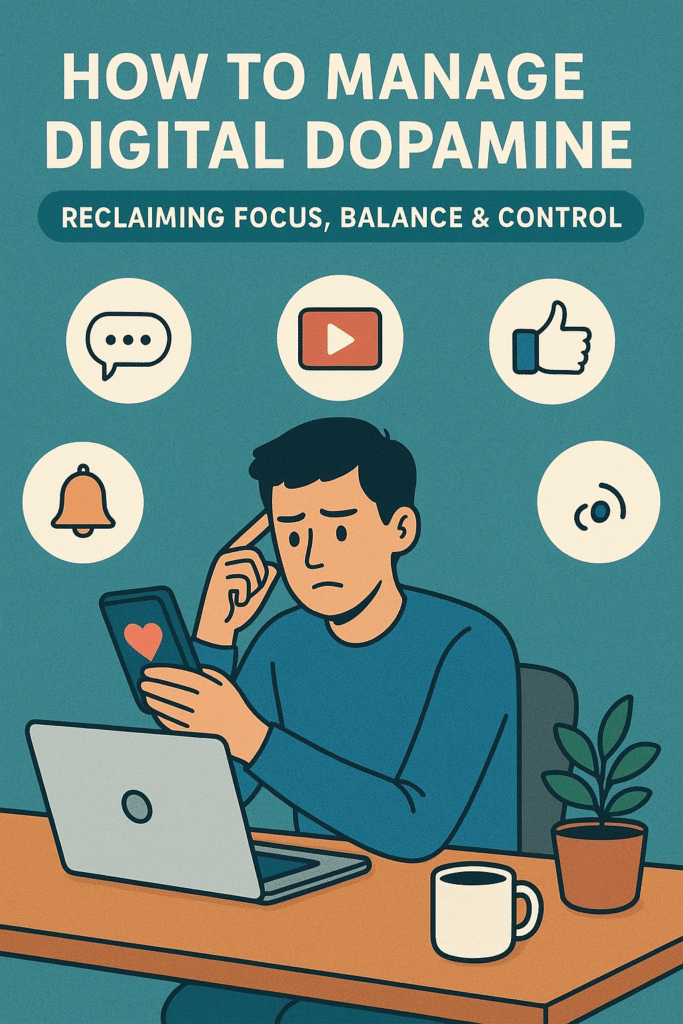
H1: Taking Back Control of Your Mind in the Digital Age
Understanding digital dopamine is only the first step. The next — and most important — is regaining control.
In a world engineered to capture attention, conscious use of technology has become a new form of intelligence.
The goal is not to eliminate dopamine but to rebalance it — channeling your brain’s reward system toward meaningful, long-term fulfillment rather than fleeting gratification.
Let’s explore practical ways to manage digital dopamine for better focus, productivity, and mental clarity.
H2: How to Reset Your Dopamine System
H3: 1. Practice a Dopamine Detox
A dopamine detox helps reset your brain’s sensitivity to pleasure. It involves temporarily avoiding high-stimulation activities such as:
- Social media
- Gaming
- Junk food
- Constant multitasking
Instead, engage in low-dopamine, high-value activities like reading, journaling, exercising, or meditating.
Even a 24-hour detox can help reduce craving cycles and improve focus. Over time, your brain re-learns to find joy in effort-based rewards rather than instant gratification.
H3: 2. Set Digital Boundaries
Boundaries create freedom.
Use technology intentionally, not impulsively.
- Turn off non-essential notifications.
- Create no-phone zones, such as during meals or before bed.
- Use app timers (e.g., Digital Wellbeing or Screen Time).
- Practice the “one-screen rule” — only one device active at a time.
By creating separation, you weaken the automatic stimulus-response loop that drives dopamine overproduction.
H3: 3. Replace Short-Term Dopamine with Long-Term Rewards
Shift from consumption to creation.
Activities that require effort — like writing, coding, drawing, or learning a skill — produce sustainable dopamine linked to satisfaction and growth.
Every time you complete a meaningful task, your brain releases dopamine — but unlike the quick spike from scrolling, this release strengthens discipline and purpose.
H3: 4. Mindful Consumption
Mindfulness transforms how we interact with technology.
Before opening an app or clicking a video, ask:
“Why am I doing this right now — for value or for distraction?”
If it’s distraction, pause and redirect.
Even 5 seconds of awareness can interrupt the dopamine craving pattern.
Mindful scrolling, digital journaling, or setting intention reminders (“Use, don’t lose focus”) can turn unconscious habits into deliberate actions.
H3: 5. Reintroduce Boredom
Boredom isn’t the enemy — it’s the gateway to creativity.
When we remove constant stimulation, the brain starts to wander, reflect, and generate ideas.
This “default mode network” is where insight and innovation emerge.
Try scheduling screen-free hours — time for silence, nature, or daydreaming.
As dopamine levels stabilize, you’ll notice increased patience, focus, and creativity.
H2: Tools & Apps for Digital Wellness
The tech world is now providing tools to fight over-stimulation with self-regulation.
H3: Recommended Tools
- Digital Wellbeing (Android): Monitors screen time and app usage.
- Apple Screen Time: Tracks and limits time on specific apps.
- Forest: Rewards you with virtual trees for staying off your phone.
- Freedom: Blocks distracting websites and apps across devices.
- Notion & Todoist: Encourage structured, goal-based productivity.
Using these tools doesn’t eliminate dopamine — it helps control its timing and source.
H2: Building a Dopamine-Friendly Lifestyle
H3: 1. Physical Movement
Exercise is nature’s dopamine reset button.
Activities like running, yoga, or dancing release dopamine, serotonin, and endorphins — balancing your neurochemistry naturally.
H3: 2. Quality Sleep
A 7–8-hour sleep cycle restores dopamine receptors and improves impulse control.
Avoid screens at least 60 minutes before bed to prevent dopamine overstimulation and blue light disruption.
H3: 3. Balanced Nutrition
Foods rich in tyrosine (like almonds, eggs, fish, and avocados) support dopamine production.
Avoid excessive sugar and caffeine, which cause rapid highs followed by crashes.
H3: 4. Social Connection
Face-to-face communication releases oxytocin and dopamine — but in a sustainable, emotionally healthy way.
Spend time offline with friends or family to rebalance your brain’s reward system.
H2: For Marketers – The Ethics of Digital Dopamine
Dopamine isn’t just a psychological concept — it’s a marketing strategy.
Neuromarketing uses dopamine triggers to influence consumer behavior.
While this can be powerful, it also raises ethical questions.
H3: Ethical Marketing Principles
- Transparency: Don’t manipulate emotions with false urgency or fear.
- Value First: Deliver genuine value before asking for engagement.
- Conscious Design: Create features that reward meaningful interactions, not endless scrolling.
- Encourage Breaks: Promote mental wellness through reminders or “pause” features.
Ethical brands are realizing that trust and wellbeing are more valuable than short-term engagement metrics.
Example:
Headspace, a mindfulness app, uses dopamine positively by rewarding users for consistency, not for endless consumption.
This builds long-term loyalty and mental health — a win-win model for both users and businesses.
H2: The Future of Digital Dopamine
As technology evolves, the next era of design will focus on “Neuro-Wellbeing.”
This movement aims to make technology more humane — supporting focus, creativity, and connection rather than distraction.
Trends to watch:
- AI-driven digital wellbeing tools that track attention and mood.
- Ethical app design frameworks that limit overstimulation.
- Virtual reality mindfulness experiences promoting calm and balance.
Tech can be both stimulating and soothing — it all depends on how consciously we use it.
H2: Conclusion – Mastering the Dopamine Equation
Digital dopamine is neither good nor bad — it’s powerful.
It can fuel innovation, creativity, and motivation when used wisely. But unchecked, it can hijack focus, weaken discipline, and damage mental health.
The real goal isn’t to quit technology, but to use it intentionally — shifting from passive consumption to purposeful engagement.
By understanding how dopamine works, setting clear digital boundaries, and prioritizing real-world rewards, we can reclaim focus, joy, and balance in a hyper-stimulated world.
Master dopamine — and you master your digital life.
SEO-Optimized FAQs on Digital Dopamine
FAQ 1: What exactly is digital dopamine?
Digital dopamine refers to the brain’s release of dopamine — the pleasure and motivation chemical — in response to digital stimuli like notifications, likes, and messages. It explains why social media, games, and online content can feel addictive.
FAQ 2: How does social media trigger dopamine release?
Social media platforms use variable rewards — unpredictable likes, comments, and content — to activate the brain’s reward system. This unpredictability creates anticipation, leading to repeated engagement and dopamine spikes.
FAQ 3: Can digital dopamine cause addiction?
Yes. Over time, constant stimulation creates tolerance and dependency, similar to substance addiction. Users crave more digital rewards to feel the same pleasure, leading to compulsive use and emotional exhaustion.
FAQ 4: How can I reduce digital dopamine overload?
Try dopamine detoxes, limit screen time, disable non-essential notifications, and practice mindful technology use. Replace short-term dopamine hits with long-term activities like reading, exercise, or creative projects.
FAQ 5: How can businesses use dopamine ethically in marketing?
Businesses can use dopamine to motivate rather than manipulate.
Reward genuine engagement, provide real value, and design products that promote wellbeing — not addiction. Ethical dopamine marketing builds trust, loyalty, and long-term growth.
Digital Dopamine How Tech Rewires the Brains Digital Dopamine How Tech Rewires the Brains Digital Dopamine How Tech Rewires the Brains Digital Dopamine How Tech Rewires the Brains Digital Dopamine How Tech Rewires the Brains Digital Dopamine How Tech Rewires the Brains Digital Dopamine How Tech Rewires the Brains Digital Dopamine How Tech Rewires the Brains Digital Dopamine How Tech Rewires the Brains Digital Dopamine How Tech Rewires the Brains Digital Dopamine How Tech Rewires the Brains Digital Dopamine How Tech Rewires the Brains Digital Dopamine How Tech Rewires the Brains Digital Dopamine How Tech Rewires the Brains Digital Dopamine How Tech Rewires the Brains Digital Dopamine How Tech Rewires the Brains Digital Dopamine How Tech Rewires the Brains Digital Dopamine How Tech Rewires the Brains Digital Dopamine How Tech Rewires the Brains Digital Dopamine How Tech Rewires the Brains Digital Dopamine How Tech Rewires the Brains Digital Dopamine How Tech Rewires the Brains Digital Dopamine How Tech Rewires the Brains Digital Dopamine How Tech Rewires the Brains Digital Dopamine How Tech Rewires the Brains Digital Dopamine How Tech Rewires the Brains Digital Dopamine How Tech Rewires the Brains Digital Dopamine How Tech Rewires the Brains Digital Dopamine How Tech Rewires the Brains Digital Dopamine How Tech Rewires the Brains Digital Dopamine How Tech Rewires the Brains Digital Dopamine How Tech Rewires the Brains Digital Dopamine How Tech Rewires the Brains Digital Dopamine How Tech Rewires the Brains Digital Dopamine How Tech Rewires the Brains