

Introduction
Search Engine Optimization (SEO) is the backbone of digital visibility. Whether you’re running a blog, eCommerce store, or corporate website, SEO helps your content reach the right audience. But when we talk about SEO, two critical pillars always come into play:On-Page SEO vs Off-Page SEO: Complete Guide.
Many beginners confuse the two or focus only on one, which limits their website’s ranking potential. In reality, both On-Page and Off-Page SEO complement each other. If On-Page SEO is the foundation of your house, Off-Page SEO is the reputation that makes others trust it.
In this complete guide, we’ll break down On-Page SEO vs Off-Page SEO, explore their differences, benefits, best practices, and provide actionable insights with real-life examples.
What is On-Page SEO?
On-Page SEO refers to all optimization techniques applied within your website to make it search engine and user-friendly. It includes optimizing content, HTML tags, site structure, speed, mobile experience, and internal linking.
Key Elements of On-Page SEO
1. Content Optimization
- Use target keywords naturally in titles, headings, and body.
- Focus on long-tail keywords (e.g., best digital marketing course for beginners instead of digital marketing course).
- Ensure your content is original, valuable, and addresses user intent.
2. Title Tags and Meta Descriptions
- Title tags should be under 60 characters and keyword-rich.
- Meta descriptions must be 150–160 characters with a compelling CTA.
3. Header Tags (H1, H2, H3)
- H1 should contain the primary keyword.
- Use H2 and H3 for structured readability.
4. URL Optimization
- Keep URLs short, descriptive, and keyword-focused.
- Example:
- ❌
www.site.com/12345?id=456 - ✅
www.site.com/on-page-seo-tips
- ❌
5. Internal Linking
- Link to relevant blog posts and pages to increase dwell time.
- Example: If you’re writing about SEO, link to articles on keyword research or technical SEO.
6. Image Optimization
- Use alt text with keywords.
- Compress images for faster loading.
7. Page Speed & Mobile Friendliness
- Google considers Core Web Vitals for ranking.
- Ensure your site loads under 3 seconds and works seamlessly on mobile.
What is Off-Page SEO?
Off-Page SEO involves all activities that happen outside your website but affect your search rankings. Its primary focus is building authority, credibility, and trustworthiness through backlinks, mentions, and social signals.
Key Elements of Off-Page SEO
1. Link Building
- High-quality backlinks remain the #1 ranking factor for Google.
- Focus on relevant, niche-specific sites instead of spammy links.
- Example: A backlink from Forbes is more powerful than 10 backlinks from unknown blogs.
2. Brand Mentions
- Even if your website isn’t linked, mentions on authority websites help boost trust.
3. Social Media Signals
- Shares, likes, and engagement on platforms like LinkedIn, Twitter, and Facebook indirectly improve SEO.
4. Guest Posting
- Writing articles for reputed websites increases visibility and backlinks.
5. Influencer Outreach
- Collaborating with influencers can drive traffic and backlinks.
6. Local SEO & Citations
- For businesses, registering on Google My Business (GMB) and local directories improves rankings in local searches.
On-Page SEO vs Off-Page SEO: Key Differences
| Factor | On-Page SEO | Off-Page SEO |
|---|---|---|
| Definition | Optimization done on the website | Efforts made outside the website |
| Focus | Content, structure, keywords, technical elements | Backlinks, brand mentions, reputation |
| Control | 100% under your control | Depends on external factors |
| Examples | Title tags, meta description, internal linking | Link building, guest posting, PR |
| Goal | Improve user experience & relevancy | Improve authority & trust |
Why Both On-Page & Off-Page SEO Are Important
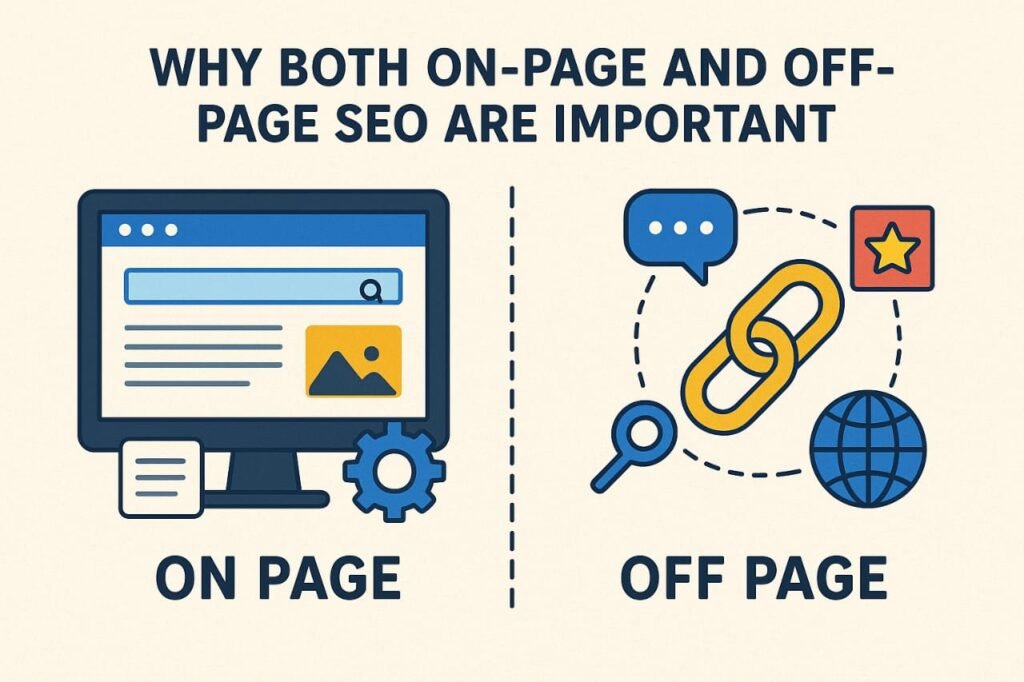
Imagine you own a beautiful restaurant (On-Page SEO). If no one talks about it, recommends it, or writes reviews (Off-Page SEO), how will new customers find you? Similarly On-Page SEO vs Off-Page SEO: Complete Guide.
- On-Page SEO ensures search engines understand your website.
- Off-Page SEO proves your website is worth ranking On-Page SEO vs Off-Page SEO: Complete Guide.
Together, they create a powerful SEO strategy On-Page SEO vs Off-Page SEO: Complete Guide.
Case Study: The Power of Combining On-Page & Off-Page SEO
A SaaS company improved its blog structure with On-Page SEO:
- Optimized titles and meta descriptions.
- Improved site speed from 5s to 2s.
- Added internal links to related guides.
At the same time, they invested in Off-Page SEO:
- Published 10 guest posts on high-authority tech websites.
- Secured backlinks from industry leaders.
- Engaged in LinkedIn discussions for brand visibility.
Results after 6 months:
- Organic traffic increased by 180%.
- Average keyword ranking improved from #25 to #8.
- Conversions grew by 65%.
This proves that neither On-Page nor Off-Page SEO alone can achieve maximum results.
Pros & Cons of On-Page SEO
✅ Pros
- Full control over optimization.
- Immediate impact on indexing.
- Improves user experience.
❌ Cons
- Limited authority building.
- Results may plateau without backlinks.
Pros & Cons of Off-Page SEO
✅ Pros
- Increases domain authority.
- Builds long-term brand reputation.
- Boosts competitive edge.
❌ Cons
- Time-consuming and challenging.
- Relies on third-party sites.
- Risk of spammy backlinks harming SEO.
Best Practices for On-Page SEO
- Optimize title tags, meta descriptions, and headers with primary keywords.
- Publish long-form, value-packed content (1500+ words).
- Use schema markup for rich snippets.
- Ensure mobile responsiveness and fast loading.
- Regularly update old blog posts.
Best Practices for Off-Page SEO
- Focus on quality backlinks over quantity.
- Build relationships with niche influencers.
- Engage in forum discussions (Quora, Reddit, niche communities).
- Leverage social media for content promotion.
- Avoid black-hat link-building tactics.
Conclusion
Both On-Page SEO and Off-Page SEO are essential for long-term success. On-Page SEO creates a strong foundation by making your website search-engine friendly and user-friendly, while Off-Page SEO builds trust, authority, and credibility On-Page SEO vs Off-Page SEO: Complete Guide.
If you want to dominate SERPs, don’t choose one over the other—combine both. Start with a solid On-Page SEO strategy, then strengthen it with sustainable Off-Page SEO practices. That’s the formula for ranking higher, driving organic traffic, and boosting conversions in 2025 and beyond On-Page SEO vs Off-Page SEO: Complete Guide.
FAQs About On-Page vs Off-Page SEO
Q1. Which is more important: On-Page SEO or Off-Page SEO?
Both are equally important. On-Page SEO helps your website get discovered,On-Page SEO vs Off-Page SEO: Complete Guide while Off-Page SEO builds authority to rank higher On-Page SEO vs Off-Page SEO: Complete Guide.
Q2. How long does it take to see results from SEO?
On-Page SEO improvements may show results in 2–4 weeks, while Off-Page SEO (backlinks,On-Page SEO vs Off-Page SEO: Complete Guide authority) can take 3–6 months.
Q3. Can I rank without Off-Page SEO?
Yes, but only for low-competition keywords. For competitive keywords, Off-Page SEO is essential On-Page SEO vs Off-Page SEO: Complete Guide .
Q4. What are some common On-Page SEO mistakes?
Keyword stuffing, duplicate content, ignoring meta tags, slow loading speed, and missing internal links On-Page SEO vs Off-Page SEO: Complete Guide.
Q5. Is link building still effective in 2025?
Yes. High-quality backlinks remain one of Google’s strongest ranking signals, but focus on relevance and authority, not spammy links On-Page SEO vs Off-Page SEO: Complete Guide.