
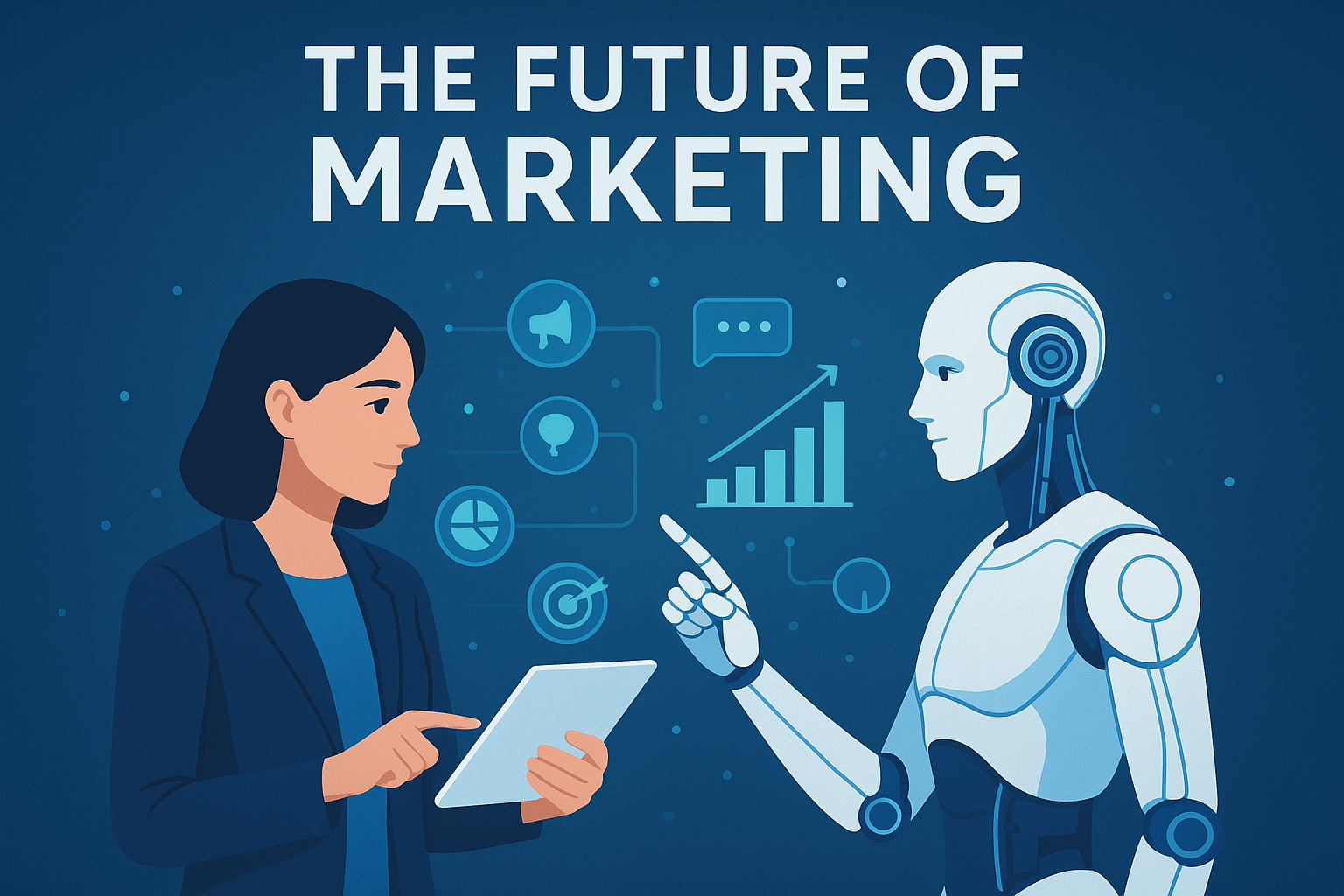
The marketing world is standing at a fascinating crossroads. On one side, we have Artificial Intelligence (AI) — data-driven, tireless, and lightning-fast. On the other, humans — creative, emotional, and intuitive. The Future of Marketing Humans AI The future of marketing is not about one replacing the other, but about how both can collaborate to create smarter, more impactful brand experiences.
From predictive analytics to AI-powered chatbots and creative automation, the marketing landscape is evolving faster than ever before. Yet, as powerful as technology becomes, the human touch remains irreplaceable.
This article explores how humans and AI will shape the future of marketing together — combining logic with emotion, automation with empathy, and precision with creativity.
How Marketing Has Evolved — From Intuition to Intelligence
Marketing has always reflected the technology and psychology of its time.
- In the 1950s–70s, marketing relied heavily on intuition, creativity, and emotional storytelling. Campaigns like Coca-Cola’s “It’s the Real Thing” or Nike’s “Just Do It” connected emotionally, but lacked precise data insights.
- In the 1990s–2000s, the internet transformed marketing into a data-driven discipline. Email campaigns, SEO, and Google Ads gave brands measurable reach and engagement.
- In the 2010s, social media and smartphones created a new attention economy — where influence, engagement, and authenticity became the new metrics of success.
- Now in the 2020s, AI is driving the next evolution — shifting marketing from data-driven to intelligence-driven.
AI tools like ChatGPT, Jasper, Midjourney, and Google Gemini are no longer optional add-ons; they’re redefining workflows, customer interactions, and creativity itself.
The AI Revolution in Marketing
AI is transforming every stage of the marketing process — from research and strategy to content creation, personalization, and analytics.
1. Content Creation and Automation
AI-powered tools can write blog posts, generate images, design ads, and even produce videos in minutes.
For instance:
- Jasper AI helps marketers write copy for ads, blogs, and social media posts.
- Canva’s AI Magic Studio can instantly design visuals based on text prompts.
- ChatGPT and Copy.ai allow for fast idea generation, SEO optimization, and even audience persona creation.
This means marketers spend less time on repetitive tasks — and more on strategy, storytelling, and creative direction.
2. Data Analysis and Consumer Insights
AI’s ability to analyze massive datasets enables predictive marketing.
- Platforms like Google Analytics 4, HubSpot, and Salesforce Einstein use AI to track customer behavior in real time and predict future actions.
- Brands can understand not just what customers did, but why they did it — and what they’re likely to do next.
For example, Netflix uses AI to recommend content with 80% accuracy, saving the company over $1 billion annually by reducing churn. Similarly, Amazon’s AI engine drives 35% of its total sales through personalized recommendations.
3. Personalization and Targeting
AI makes hyper-personalization possible — delivering content, ads, and offers that align perfectly with individual interests.
- Email platforms like Klaviyo and ActiveCampaign use AI to personalize subject lines and send times based on user engagement patterns.
- Social platforms like Meta (Facebook) and TikTok use machine learning to tailor feeds and ads, creating deeply individualized user experiences.
Personalization increases engagement rates by up to 80%, according to a 2023 McKinsey report — proving that relevance is now the currency of attention.
4. Chatbots and Conversational Marketing
AI-driven chatbots like Drift, ManyChat, and Intercom enable 24/7 customer engagement.
They answer questions, guide purchases, and nurture leads automatically.
According to Juniper Research, chatbots will save businesses over $8 billion annually by 2026, while improving customer satisfaction by 30%.
But here’s the key — customers still prefer human-like conversations. The most effective chatbots today are those that blend AI efficiency with human tone, empathy, and context awareness.
Real-World Case Studies — When AI Meets Marketing Success
Case Study 1 — Coca-Cola’s “Create Real Magic” Campaign
Coca-Cola launched its “Create Real Magic” campaign using OpenAI’s DALL·E and GPT models, allowing users to co-create Coca-Cola-themed artwork.
It generated millions of social shares, demonstrating how AI can amplify human creativity rather than replace it.
Case Study 2 — Sephora’s Virtual Artist
Beauty brand Sephora uses AI-powered virtual try-on experiences.
Users can test makeup products virtually via augmented reality (AR), guided by AI.
This innovative approach led to a 200% increase in engagement and a 30% lift in conversion rates.
Case Study 3 — Netflix’s Predictive AI
Netflix’s recommendation engine is an AI marvel.
By analyzing millions of viewing habits, it personalizes every user’s homepage.
This personalization boosts retention rates and keeps over 230 million global subscribers hooked.
These examples highlight a new truth: AI amplifies what humans imagine.
Why the Future Is About Collaboration, Not Replacement
Contrary to fear-driven headlines, AI isn’t here to steal marketing jobs — it’s here to reshape them.
While AI handles the “how” — the automation, analytics, and scaling — humans still define the “why”: the emotional core of storytelling, ethics, creativity, and brand identity.
In the next decade, the most successful marketers won’t be purely technical or purely creative — they’ll be “hybrid marketers”, fluent in both AI tools and human psychology.
As Harvard Business Review notes:
“The future belongs to marketers who can teach machines to think — and think like humans themselves.”
The Human Edge — Emotion, Ethics, and Empathy
AI can mimic tone, structure, and data, but it cannot feel.
It doesn’t understand heartbreak, humor, irony, or social nuance the way humans do.
That’s why emotion-driven storytelling will remain the most powerful weapon in marketing.
Brands like Apple, Nike, and Airbnb thrive not just because of smart algorithms, but because they connect emotionally with people.
Human marketers ensure that campaigns are authentic, ethical, and inclusive — something no AI can fully replicate.
Welcome to the Human–AI Collaboration Era
The 2020s are not about AI replacing humans, but rather about humans learning to collaborate with AI — creating a new era of “augmented creativity.”
In this era, marketers are not just strategists or creatives; they are orchestrators — guiding algorithms, training AI models, and curating personalized experiences at scale.
AI is now the co-pilot of marketing, helping humans make smarter, faster, and more impactful decisions.
Let’s explore how this collaboration works in real-world scenarios — and what it means for the future of marketing.
How Humans and AI Work Together
1. Strategy + AI Insights
Humans define marketing goals, tone, brand values, and messaging.
AI supports them by:
- Analyzing consumer behavior patterns
- Predicting content performance
- Suggesting timing and channels for campaigns
Example:
A human marketer decides to launch a new eco-friendly clothing line.
AI tools like Google Trends, Ahrefs, or MarketMuse analyze the audience demand, trending keywords, and competitors — providing actionable insights for campaign success.
2. Creativity + Automation
While AI generates variations of ads, taglines, or visuals, humans bring emotional intelligence — deciding which message resonates best with their audience.
Example:
When Burger King used AI-generated ads in a campaign, it went viral — not because AI wrote them perfectly, but because humans used humor and irony to make fun of AI’s quirks.
This shows that creativity doesn’t die with AI; it evolves.
3. Personalization + Human Sensitivity
AI can segment audiences based on data points like behavior, location, and purchase history.
But only humans can decide how far personalization should go without crossing ethical lines.
Example:
If AI suggests showing baby product ads to someone who recently lost a child, a human’s moral judgment prevents emotional harm.
That’s why empathy-driven marketing is irreplaceable — and why AI must always operate under human supervision.
The Pros and Cons of AI-Driven Marketing
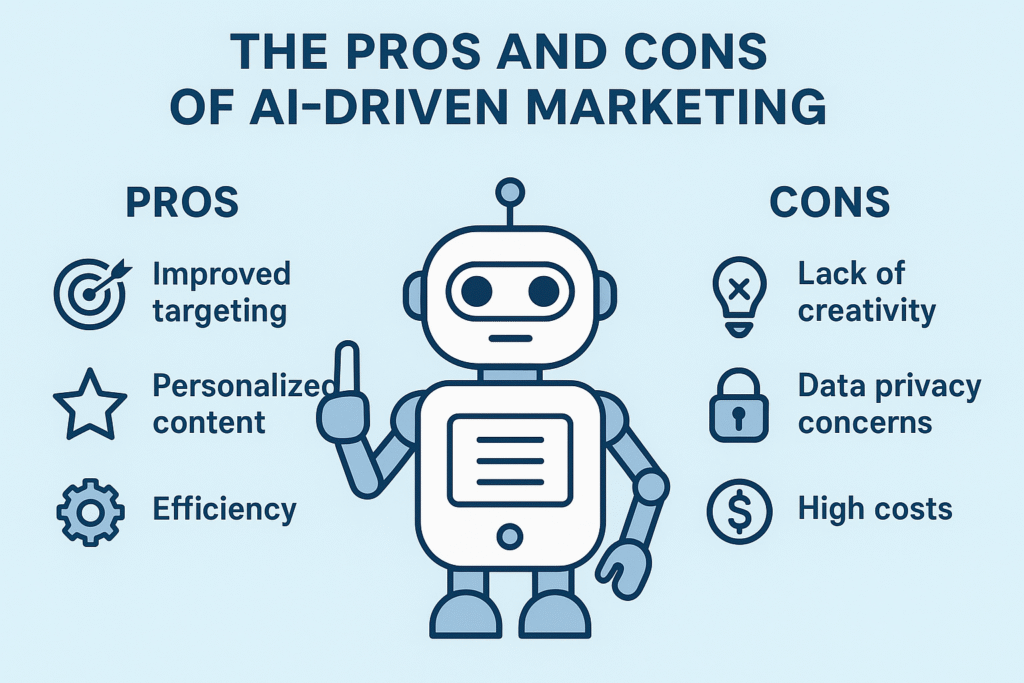
Every major shift in technology brings benefits and challenges.
Let’s break down the advantages and limitations of AI in marketing.
Pros of AI in Marketing
1. Efficiency and Speed
AI saves time by automating repetitive tasks — from keyword research to ad optimization.
According to Accenture, AI can increase marketing productivity by up to 40%.
2. Better Decision-Making
AI processes billions of data points in seconds — something no human team could do.
This leads to data-backed decisions, minimizing guesswork.
3. Enhanced Personalization
AI enables 1:1 marketing at scale.
For instance, Spotify’s “Discover Weekly” playlist is a perfect example of AI-driven personalization — blending data with delight.
4. Cost-Effectiveness
AI tools can replace multiple manual roles, helping startups and small businesses compete with larger brands.
5. Predictive Analytics
AI can forecast future trends — helping marketers stay ahead of consumer behavior.
For example, AI models can predict which social trends will go viral or which products will perform well next quarter.
Cons of AI in Marketing
1. Lack of Emotional Understanding
AI can analyze tone but doesn’t understand emotion.
Without human oversight, campaigns risk sounding robotic or insensitive.
2. Ethical & Privacy Concerns
AI’s reliance on user data raises privacy issues.
According to a 2024 Statista report, 67% of consumers worry about how brands use their data for AI targeting.
3. Dependence on Algorithms
Marketers may become over-reliant on automation, leading to creative stagnation or loss of authentic brand voice.
4. Bias and Inaccuracy
AI models learn from data — and data can be biased.
If not checked, this can lead to unfair targeting or exclusion of certain groups.
5. Job Displacement Fears
While AI creates new roles (like AI prompt engineers or data ethicists), it also automates others — causing workforce anxiety.
However, studies by PwC suggest that AI will create more marketing jobs than it replaces by 2030.
Essential AI Tools for Modern Marketers
To stay competitive, marketers must know which AI tools to adopt.
Here are categories and examples of the most effective tools in 2025:
1. Content Creation & Copywriting
- ChatGPT / Jasper / Copy.ai – Blog posts, emails, and social media content.
- Writesonic – Landing page and ad copy generation.
- SurferSEO / Frase.io – SEO optimization powered by AI.
💡 Example:
A digital marketer can produce 5 optimized blog drafts in a day using ChatGPT and SurferSEO instead of writing from scratch.
2. Design & Visual Marketing
- Canva Magic Studio / Adobe Firefly / Midjourney – Generate brand visuals and ad creatives.
- Runway ML – AI-powered video editing and content repurposing.
These tools reduce production costs and speed up design workflows.
3. Analytics & Customer Insights
- HubSpot AI / Salesforce Einstein / Google Analytics 4 – Real-time audience insights.
- Crimson Hexagon – AI sentiment analysis for brand reputation.
- Brandwatch – Predicts social media trends using machine learning.
4. Advertising & Automation
- Meta Advantage+, Google Performance Max, and LinkedIn Campaign Manager AI – Automate targeting and ad placement.
- Zapier AI – Integrates multiple tools for workflow automation.
💡 Example:
A campaign that once took a week to plan and execute can now be launched in less than a day with AI-powered automation.
5. Chatbots & Conversational AI
- Drift, Intercom, ManyChat, and Landbot – Handle real-time conversations, lead capture, and support.
- Chatbase – Train custom chatbots using your brand data.
AI chatbots can answer 80% of customer queries instantly, freeing human agents to handle complex cases.
Skills Marketers Need to Thrive in an AI World
AI won’t replace marketers — but marketers who know AI will replace those who don’t.
Here are the key skills for the future:
1. Prompt Engineering
Learning to give AI the right instructions is the new superpower.
A well-crafted prompt can produce 10x better content outcomes.
2. Data Literacy
Understanding analytics, algorithms, and audience insights helps marketers use AI tools effectively.
3. Emotional Storytelling
Even in an AI-driven world, authentic human stories remain the ultimate conversion driver.
4. Ethical Marketing
Marketers must know how to use AI responsibly — ensuring transparency, inclusivity, and privacy protection.
5. Creative Strategy
AI can suggest ideas, but humans must set creative direction — defining tone, purpose, and brand meaning.
Real-Life Example — The AI-Powered Campaign of Heineken
Heineken’s campaign “Cheers to All” combined AI insights with human creativity.
AI analyzed millions of conversations about gender stereotypes in drinking habits.
The creative team then built a message that celebrated equality in humor and style.
The result?
- 40 million+ views on social media
- 70% positive sentiment increase
- Stronger emotional brand connection
This shows the power of data + empathy = impact.
Actionable Insights for Marketers
✅ 1. Don’t fight AI — master it.
Use it to amplify your ideas, not replace them.
✅ 2. Create AI-human workflows.
Assign tasks: let AI handle analytics, while humans craft strategy.
✅ 3. Stay authentic.
Use AI-generated content as a base — but always infuse your voice.
✅ 4. Keep learning.
AI is evolving fast; stay updated with tools, ethics, and trends.
✅ 5. Prioritize user trust.
Transparency builds long-term relationships more than automation ever can.
🧭 In Summary
The Human–AI Collaboration Era isn’t a distant dream — it’s already here.
The future belongs to marketers who merge AI’s precision with human passion.
As we transition into this hybrid future, creativity will be the bridge — and collaboration will be the key.
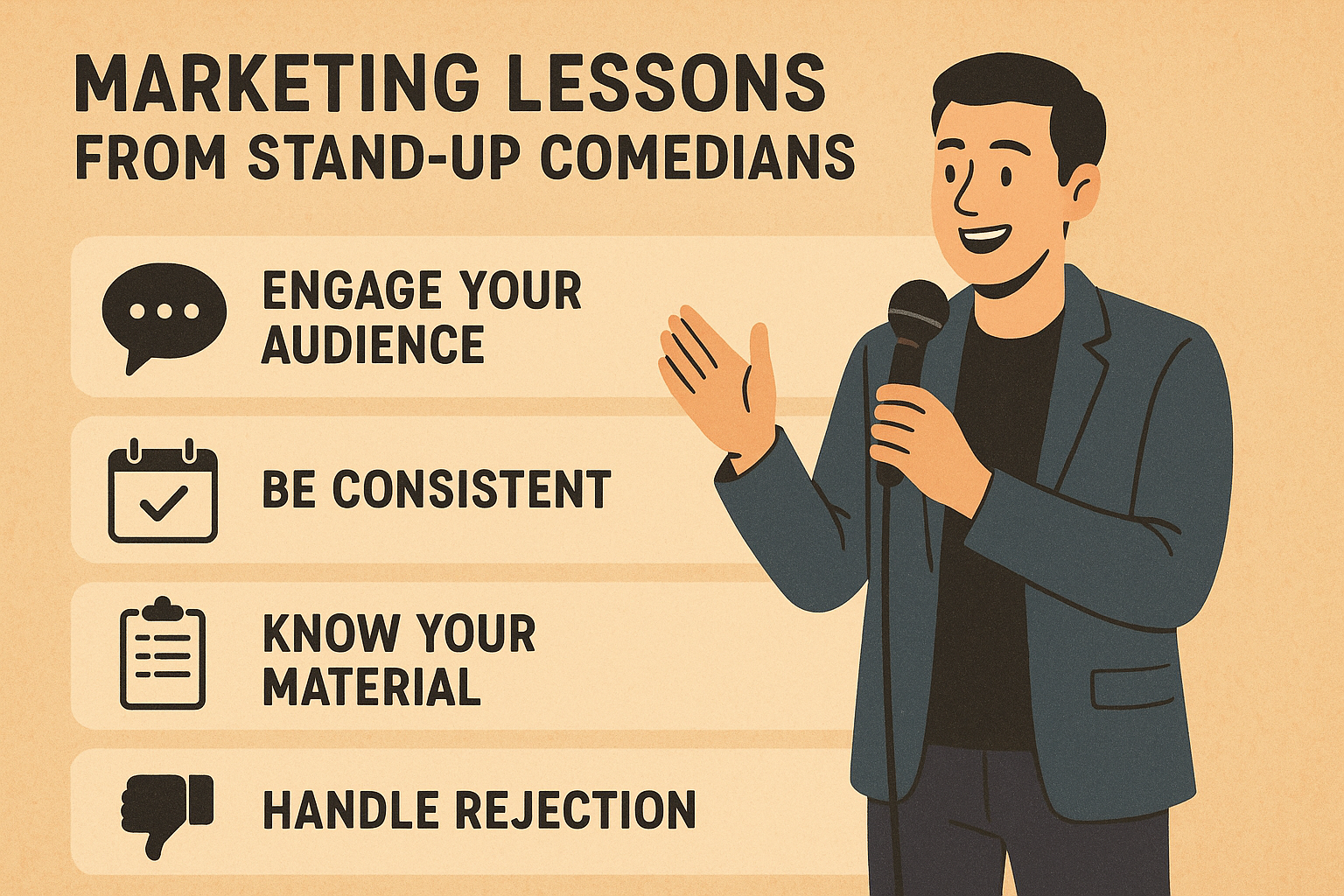
Marketing Lessons from Stand-Up Comedians
Lesson 6 – Handle Failure Like a Comedian
Every Bomb Is a Lesson
Even the best comedians fail. Jokes fall flat. Audiences stay silent. But here’s what separates professionals from amateurs—they learn, adapt, and come back stronger. Failure isn’t the end; it’s feedback.
In marketing, failed campaigns, low engagement, or poor ROI are not defeats—they’re data points. Each setback reveals insights about your audience, messaging, or timing.
Real-Life Example
Jerry Seinfeld spent years performing in small clubs before creating Seinfeld, one of the most successful sitcoms ever. He constantly refined jokes based on crowd reactions. His resilience in facing repeated rejection made him a legend.
Similarly, brands like Coca-Cola learned from their marketing missteps. The infamous “New Coke” fiasco in 1985 taught them the importance of consumer sentiment—leading to a stronger focus on brand loyalty.
Actionable Takeaway for Marketers
- Treat failure as testing, not loss.
- Conduct post-campaign analysis to identify what went wrong.
- Encourage a creative, experimental culture within your team.
Comedic wisdom: You can’t make everyone laugh—and you can’t please every customer. Focus on those who connect with your message.
Lesson 7 – Engage Your Audience in Real Time
The Energy Exchange
Great comedians read their audience constantly. They adjust tone, speed, and jokes based on crowd response. It’s a live dialogue, not a monologue.
Digital marketers must do the same. Engagement is no longer one-way—it’s a real-time conversation between brand and audience.
Real-Life Example
When Wendy’s turned their Twitter account into a witty, sarcastic persona, it redefined fast-food marketing. Their real-time interactions and humorous comebacks gained millions of followers, viral engagement, and a refreshed brand image.
Comedians and marketers both thrive when they make audiences feel seen and heard.
Actionable Takeaway for Marketers
- Respond to comments, mentions, and feedback in real time.
- Use interactive formats like polls, memes, and live videos.
- Monitor analytics to measure engagement quality—not just quantity.
Comedic wisdom: A great show is co-created with the audience. A great brand is built with the community.
Lesson 8 – Turn Content into Community
From Fans to Tribe
The most successful comedians don’t just perform—they build communities. They cultivate loyal fans who share content, attend shows, and support them across platforms.
This transformation—from audience to tribe—is the secret to long-term success.
For marketers, this means going beyond conversions. The goal is to create a community around shared values, humor, and identity.
Real-Life Example
Andrew Schulz, an American comedian, built his fame not through traditional TV but through YouTube and podcasts. He engaged directly with his followers, shared behind-the-scenes clips, and built a dedicated online tribe before mainstream success.
Brands like Glossier and Gymshark replicate this model. They use community-led marketing—encouraging fans to share stories, photos, and experiences. The result: organic growth and fierce loyalty.
Actionable Takeaway for Marketers
- Create platforms for audience interaction—forums, comment sections, or social groups.
- Use humor and storytelling to make people feel part of something bigger.
- Reward engagement through shoutouts, giveaways, or collaborations.
Comedic wisdom: A great joke ends with laughter—a great brand ends with belonging.
Pros & Cons of Using Humor in Marketing
| Pros | Cons |
|---|---|
| ✅ Increases emotional engagement and recall | ⚠️ Risk of offending or alienating audiences |
| ✅ Makes content shareable and viral | ⚠️ Humor can distract from the message if misused |
| ✅ Builds brand personality and likability | ⚠️ Cultural differences may cause misinterpretation |
| ✅ Encourages relatability and trust | ⚠️ Hard to measure ROI of humor-driven campaigns |
Tips to Balance Humor Effectively:
- Test jokes with small audiences before scaling.
- Keep humor inclusive, clean, and relevant.
- Always connect humor back to your core brand message.
The Grand Takeaway – What Marketers Can Learn from Comedians
- Listen deeply – Know your audience like a crowd at a comedy club.
- Tell stories – Use emotional storytelling to connect beyond logic.
- Be authentic – Show vulnerability and transparency.
- Keep testing – Treat campaigns like evolving sets.
- Build your voice – Consistency makes you memorable.
- Embrace failure – Every “bomb” teaches improvement.
- Engage in real time – Marketing is a dialogue, not a monologue.
- Build community – Fans make brands timeless.
Comedy teaches us that the art of connection isn’t just about laughter—it’s about human truth. In a world full of noise, the brands that dare to be human, humorous, and heartfelt will always stand out.
Conclusion – The Laughing Marketer’s Advantage
In today’s attention-deficit digital world, authentic engagement is the new currency. Comedians thrive because they understand emotion, timing, and connection—three pillars that every marketer needs.
Whether you’re selling a product, promoting a service, or building a brand, remember this:
👉 Marketing is just another stage, and your audience is waiting for your best story.
The next time you craft a campaign, think like a comedian:
- Know your crowd.
- Tell a relatable story.
- Time your delivery.
- And never stop refining your set.
Because when marketing meets comedy, brands don’t just sell—they resonate.
FAQs – Marketing Lessons from Stand-Up Comedians
H3: 1. Why should marketers learn from stand-up comedians?
Comedians are masters of audience psychology, storytelling, and real-time engagement. These skills help marketers create campaigns that are more relatable, emotional, and memorable.
H3: 2. How can humor improve marketing performance?
Humor triggers emotional responses, boosts brand recall, and increases shareability. Studies show that humorous ads are 33% more likely to go viral than non-humorous ones.
H3: 3. What are the risks of using humor in branding?
Poorly executed humor can alienate or offend audiences. To avoid backlash, brands must ensure jokes align with their tone, culture, and audience values.
H3: 4. Which brands use comedian-style marketing effectively?
Brands like Wendy’s, Old Spice, Zomato, and Aviation Gin use witty, conversational humor to connect with younger audiences and stand out in crowded markets.
H3: 5. How can small businesses apply these comedy-based marketing lessons?
Start with authenticity. Use relatable humor in captions, ads, and storytelling. Engage followers directly and build a consistent voice that reflects your brand’s personality.
The Future of Marketing Humans AI The Future of Marketing Humans AI The Future of Marketing Humans AI The Future of Marketing Humans AI The Future of Marketing Humans AI The Future of Marketing Humans AI The Future of Marketing Humans AI The Future of Marketing Humans AI The Future of Marketing Humans AI The Future of Marketing Humans AI The Future of Marketing Humans AI The Future of Marketing Humans AI The Future of Marketing Humans AI The Future of Marketing Humans AI The Future of Marketing Humans AI The Future of Marketing Humans AI The Future of Marketing Humans AI The Future of Marketing Humans AI The Future of Marketing Humans AI The Future of Marketing Humans AI The Future of Marketing Humans AI The Future of Marketing Humans AI The Future of Marketing Humans AI The Future of Marketing Humans AI The Future of Marketing Humans AI The Future of Marketing Humans AI The Future of Marketing Humans AI The Future of Marketing Humans AI The Future of Marketing Humans AI The Future of Marketing Humans AI The Future of Marketing Humans AI The Future of Marketing Humans AI The Future of Marketing Humans AI The Future of Marketing Humans AI