

In today’s hyper-competitive world, brands are no longer just selling products — they are selling emotions, experiences, and memories. Traditional marketing relies on surveys, focus groups, and analytics, What Is Neuromarketing? How It Works Explained but these methods often fail to capture the true drivers of human decisions — the subconscious mind.
That’s where Neuromarketing steps in.
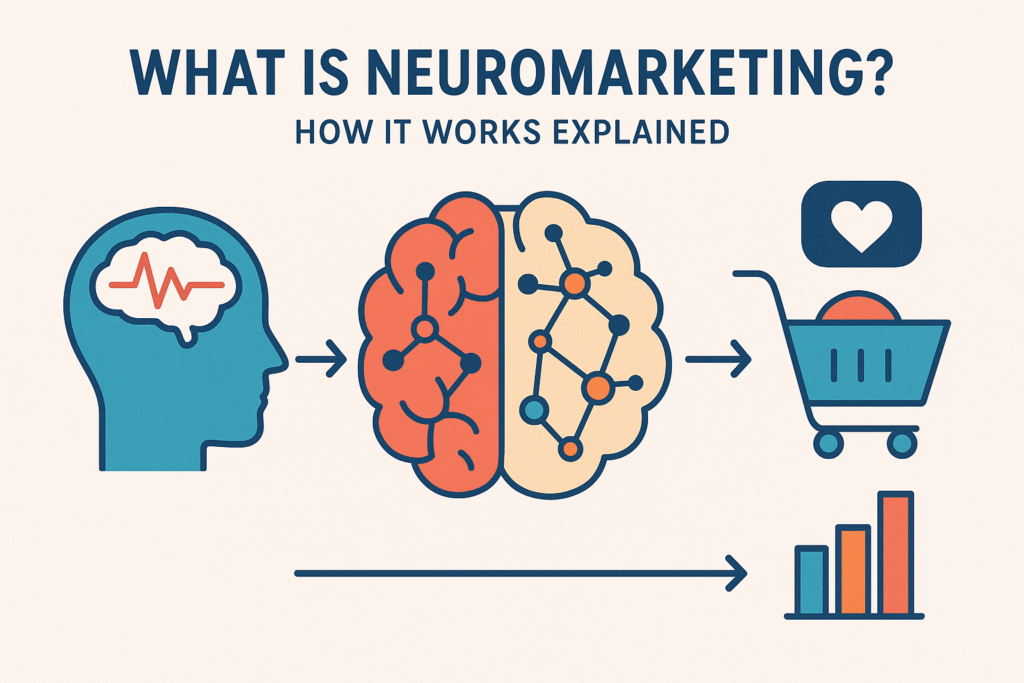
Neuromarketing is a revolutionary field that combines neuroscience, psychology, and marketing to understand how consumers’ brains respond to advertising, branding, and product experiences. Instead of guessing what customers like, neuromarketing measures their brain activity, eye movements, heart rate, and emotions to uncover what truly influences buying decisions.
H2: Defining Neuromarketing
Neuromarketing can be defined as:
“The application of neuroscience techniques to marketing research, studying consumers’ sensorimotor, cognitive, and emotional responses to marketing stimuli.”
In simpler words, it helps marketers understand why people buy what they buy — by studying how their brains react to advertisements, packaging, colors, sounds, and even website layouts.
For example:
- When you see a Coca-Cola ad, your brain releases dopamine, a “feel-good” hormone associated with happiness and nostalgia.
- Neuromarketing researchers can track these responses using fMRI (functional Magnetic Resonance Imaging) or EEG (Electroencephalography) to see which parts of the brain light up during the ad.
H2: The Science Behind Neuromarketing
Our brains are wired to make decisions emotionally first and rationally later. According to Harvard professor Gerald Zaltman, 95% of purchasing decisions are subconscious.
Neuromarketing studies focus on three brain regions critical to marketing behavior:
- The Neocortex (Thinking Brain): Handles logic, analysis, and reasoning.
- The Limbic System (Emotional Brain): Controls emotions, memories, and relationships.
- The Reptilian Brain (Instinctive Brain): Makes fast, survival-based decisions — “Do I want this or not?”
When you see an ad, all three interact — but the emotional and instinctive parts dominate the final choice. That’s why storytelling, music, colors, and emotional imagery are so powerful in advertising.
H3: Key Tools and Techniques Used in Neuromarketing
Neuromarketing relies on advanced technologies to measure consumer reactions. Some of the most used tools include:
- fMRI (Functional Magnetic Resonance Imaging):
Measures brain activity by detecting blood flow changes. It shows which areas activate during exposure to marketing material.
Example: Researchers at Baylor College found that Coca-Cola triggers stronger brain responses in memory and emotion centers than Pepsi — explaining Coke’s brand loyalty. - EEG (Electroencephalography):
Tracks electrical activity in the brain to identify emotional engagement, excitement, or frustration. - Eye Tracking:
Measures where people look and for how long — used for website layouts, packaging, and ad design optimization. - Facial Coding:
Detects micro-expressions to gauge emotions like happiness, surprise, or confusion. - Biometrics (Heart Rate, Skin Conductance, etc.):
Tracks physiological responses to understand arousal or stress levels during marketing exposure.
H3: Neuromarketing in Simple Terms
Imagine you’re designing a product box. Traditional research might tell you customers “like red.”
Neuromarketing tells you why — because red triggers urgency and excitement in the amygdala, part of the brain that drives emotional response.
That’s the power of neuromarketing — understanding emotion, not just opinion.
H2: Why Neuromarketing Matters in Modern Marketing
- It Predicts Consumer Behavior Better:
Instead of relying on “what people say,” neuromarketing shows “how people feel.” - It Creates Emotional Brand Connections:
Emotions drive loyalty. Apple, Nike, and Coca-Cola use neuromarketing to evoke specific emotional associations — innovation, empowerment, happiness. - It Enhances Marketing ROI:
By using neuroscience, brands can optimize ads and packaging for maximum subconscious appeal, saving millions in ineffective campaigns.
H3: Real-World Example – The Pepsi vs. Coca-Cola Experiment
In a famous 2004 Baylor College of Medicine study, participants were given Coke and Pepsi samples while their brain activity was scanned.
- When they didn’t know which was which, most preferred Pepsi (taste response).
- But when told which was Coke, the brain’s prefrontal cortex and hippocampus lit up, linked to brand loyalty and emotion.
Conclusion: Coke’s branding created a stronger emotional connection than Pepsi’s taste — a perfect example of neuromarketing at work.
H4: The Psychology Behind Consumer Choices
Marketing doesn’t just target logic — it targets feelings.
Neuromarketing shows that:
- People respond faster to emotional ads than informational ones.
- Colors, sounds, and even fonts influence mood and trust.
- Music can trigger nostalgia or excitement, shaping brand perception.
H2: Summary of Part 1
Neuromarketing bridges the gap between psychology and marketing. It decodes how emotions, memories, and subconscious triggers shape our purchasing behavior.
In short — it’s marketing that speaks the language of the brain.
Applications, Tools, and Real-Life Examples of Neuromarketing
H1: How Neuromarketing Is Applied in Real-World Marketing
Now that we understand the science behind neuromarketing, let’s explore how brands actually use it to influence consumer behavior, improve marketing performance, and build emotional loyalty.
Neuromarketing is not just about brain scans — it’s about turning subconscious insights into marketing strategies that drive results. From designing websites to crafting advertisements and packaging, brands across industries are integrating neuroscience to decode what makes people feel, engage, and buy.
H2: Top Real-Life Applications of Neuromarketing
1. Advertising Optimization
Marketers use neuromarketing to test ad effectiveness before launch. By analyzing viewers’ brain and emotional responses, they can determine:
- Which parts of the ad capture the most attention.
- Which scenes evoke positive or negative emotions.
- When the viewer’s engagement drops.
For example, Google and MediaVest conducted a study using EEG and eye-tracking to analyze how users react to YouTube ads. They found that ads with human faces and emotional storytelling generated 30% higher engagement than those with only product visuals.
2. Branding and Logo Design
Logos are not just visual symbols — they are emotional triggers.
Through neuromarketing, companies test different colors, shapes, and fonts to evoke the desired emotional reaction.
- Apple’s minimalist logo stimulates the brain’s “reward system” linked to simplicity and innovation.
- McDonald’s yellow and red colors trigger hunger and excitement — activating the hypothalamus (hunger center).
- Nike’s swoosh creates a sense of motion, energy, and achievement, which aligns perfectly with its “Just Do It” philosophy.
Neuroscience-backed branding ensures that the first impression triggers the right feeling — before a consumer even reads a slogan.
3. Website and UX Design
Digital marketers use neuromarketing principles to improve website design and user experience (UX). Eye-tracking and heat-mapping tools reveal:
- Where users focus their attention.
- Which sections cause confusion.
- Which CTAs (Call-to-Actions) drive the most clicks.
A HubSpot neuromarketing study showed that websites designed using eye-tracking data improved conversion rates by up to 40%.
For example:
- Faces looking toward the “Sign Up” button increase clicks.
- Red buttons trigger urgency, while green buttons convey trust.
4. Product Packaging and Design
Consumers often make purchasing decisions in just a few seconds — and packaging plays a crucial role.
Neuromarketing helps brands test which designs activate the pleasure and reward centers in the brain.
Example:
- Campbell’s Soup Company redesigned its packaging after neuromarketing research showed that people had no emotional connection to the old design. They changed label colors, removed the spoon image, and adjusted the steam visuals — resulting in a 12% increase in sales.
5. Pricing and Value Perception
Price perception isn’t purely rational — it’s emotional.
Neuromarketing helps brands identify psychological price points that make products feel affordable or premium.
Example:
- “$9.99” instead of “$10” works because the brain perceives it as a smaller number — a principle called left-digit bias.
- Neuroscientists found that higher prices can actually increase perceived quality, activating the medial orbitofrontal cortex (pleasure center). This is why luxury brands rarely discount — they protect the brain’s premium association.
6. In-Store Marketing and Retail Experience
Retailers use neuromarketing to shape store environments that subconsciously encourage spending.
For instance:
- Background music influences shopping speed. Slow music increases browsing time and sales volume.
- Scent marketing is another powerful tool. Studies show that pleasant scents can boost purchase intent by up to 80%.
- Example: Abercrombie & Fitch uses a signature fragrance in its stores to evoke youthful excitement and identity.
- Lighting and layout also affect emotion — warm tones create comfort, while bright lighting enhances attention to detail.
H2: Advanced Neuromarketing Tools and Technologies
1. Functional MRI (fMRI)
Used for deep insights into emotional processing.
- Measures brain blood flow to pinpoint which regions activate during ad exposure.
- Expensive but highly accurate.
Use case: TV commercials, film trailers, brand loyalty studies.
2. Electroencephalography (EEG)
Tracks real-time electrical signals in the brain.
- Portable and cost-effective.
- Identifies excitement, frustration, or boredom.
Use case: Website testing, ad engagement measurement.
3. Eye-Tracking Cameras
Monitors where the user’s gaze lands first and how long they focus.
- Helps optimize visual hierarchy.
Use case: E-commerce websites, packaging, print ads.
4. Facial Expression Analysis
Uses AI to decode subtle micro-expressions (smiles, frowns, surprise).
Use case: Video ad testing, emotional storytelling.
5. Galvanic Skin Response (GSR)
Measures sweat gland activity to detect emotional arousal.
Use case: Emotional intensity tracking during ad exposure.
6. Implicit Association Tests (IAT)
Tests unconscious brand associations by measuring response times to paired words or images.
Use case: Brand preference and loyalty analysis.
H3: Neuromarketing in Digital Advertising
With the digital landscape evolving, brands are applying neuromarketing insights to social media, video ads, and influencer marketing.
- YouTube Pre-Roll Ads: Emotional hooks in the first 5 seconds lead to 75% higher completion rates.
- Instagram Ads: Images with human faces perform 1.5x better due to the brain’s facial recognition bias.
- Influencer Marketing: The brain perceives influencer recommendations as social proof, activating trust and mirror neurons.
Brands like Spotify and Netflix even use neuromarketing data to personalize user experiences and recommendation algorithms — ensuring emotional resonance with content.
H3: Case Studies — Neuromarketing in Action

Case Study 1: Frito-Lay
Frito-Lay used neuromarketing to analyze how women reacted to their ads and packaging. The results showed:
- Glossy bags and cheesy visuals triggered guilt (negative emotion).
- Matte packaging with healthy cues (like baked chips) triggered comfort and acceptance.
After redesigning, Frito-Lay saw a 15% increase in female customer engagement.
Case Study 2: Hyundai
Hyundai invited participants to view new car prototypes while undergoing EEG scans. The data revealed which design elements evoked excitement or stress.
Based on these findings, Hyundai modified its exterior designs — resulting in improved consumer appeal and global sales growth.
Case Study 3: PayPal
PayPal found through neuromarketing that users responded more strongly to speed and convenience messaging rather than security and safety.
By emphasizing “Fast and Easy Payments,” PayPal increased click-through rates by over 200%.
H2: Benefits of Using Neuromarketing
| Benefit | Explanation |
|---|---|
| Emotional Insight | Understand real emotions beyond verbal feedback. |
| Accurate Prediction | Identify what truly drives conversions. |
| Optimized Ad Spend | Focus budget on content proven to resonate. |
| Enhanced Creativity | Combine data and emotion for better storytelling. |
| Brand Loyalty | Build deeper emotional connections that last. |
H3: Neuromarketing Across Industries
- Retail & FMCG: Product design, packaging, shelf placement.
- Technology: User experience, app engagement, brand trust.
- Entertainment: Movie trailers, streaming recommendations.
- Healthcare: Patient communication, public health campaigns.
- Politics: Campaign messaging, voter emotion tracking.
H4: Example – Neuromarketing in the Automotive Industry
Car manufacturers like BMW, Audi, and Toyota use neuromarketing to study:
- Which dashboard designs feel most intuitive.
- What color interiors trigger comfort.
- Which sound (engine tone) evokes luxury or power.
The emotional connection between the driver and the car becomes part of the brand identity.
H2: Summary of Part 2
Neuromarketing is transforming modern marketing into a science-driven art.
From ad creation to packaging, it helps brands align with the subconscious desires of consumers.
Whether you’re designing a logo or launching a global campaign, understanding the brain behind the buy is your ultimate competitive advantage.
Ethics, Pros & Cons, Future Trends & FAQs

H1: The Ethical Side of Neuromarketing
While neuromarketing offers revolutionary insights into human behavior, it also raises critical ethical questions.
By studying subconscious reactions, companies gain access to hidden emotional triggers that even consumers themselves might not be aware of. This creates both power and responsibility.
H2: Major Ethical Concerns in Neuromarketing
1. Consumer Manipulation
Critics argue that neuromarketing could be used to manipulate consumers into making purchases they don’t actually need.
When brands understand emotional vulnerabilities, they might exploit them — blurring the line between persuasion and manipulation.
Example:
If a brand discovers that sadness increases spending, they could intentionally design ads that evoke melancholy emotions. While effective, this raises moral concerns.
2. Privacy and Brain Data
Neuromarketing involves collecting biometric and neurological data, such as eye movements and brain scans.
Although this data is anonymized, there are concerns about data privacy, ownership, and consent.
Consumers deserve to know how their brain data is used and for what purpose — transparency must be central to neuromarketing research.
3. Emotional Exploitation
There’s a thin line between emotional storytelling and emotional manipulation.
Ethical neuromarketing focuses on creating positive, empowering experiences — not exploiting fear, anxiety, or insecurity to sell more.
4. Informed Consent
Participants in neuromarketing studies should always give clear, informed consent. This ensures ethical compliance and public trust in neuroscience-driven marketing.
H3: Responsible Neuromarketing Practices
To ensure ethical use, leading organizations follow these principles:
- Transparency: Clearly inform participants about data usage.
- Non-Manipulative Intent: Use neuromarketing to improve experiences, not exploit emotions.
- Beneficial Purpose: Focus on value creation — better design, safer ads, and more meaningful connections.
- Regulatory Oversight: Follow ethical guidelines set by associations like the Neuromarketing Science & Business Association (NMSBA).
In short — neuromarketing should serve people, not control them.
H2: Advantages and Disadvantages of Neuromarketing
H3: Key Advantages
- Deeper Consumer Insight:
Reveals emotional and subconscious motivations that traditional research misses. - Improved Marketing Effectiveness:
Helps create ads and packaging that resonate emotionally — increasing engagement and sales. - Higher ROI:
Reduces wasteful ad spending by focusing on what truly works. - Enhanced Brand Loyalty:
Builds emotional connections that sustain long-term relationships. - Product Development:
Helps design user-centric products that “feel right” from the start.
H3: Key Disadvantages
- High Cost:
Advanced tools like fMRI and EEG are expensive and often inaccessible to small businesses. - Complex Data Interpretation:
Brain data requires expert neuroscientists to analyze — not always straightforward. - Ethical Risks:
Misuse of data can harm trust and raise manipulation concerns. - Limited Scalability:
Large-scale studies are difficult due to equipment and participant limitations. - Cultural Differences:
Emotional triggers vary across regions and cultures, affecting results.
H2: The Future of Neuromarketing (2030 Vision)
The future of neuromarketing lies at the intersection of AI, machine learning, and neuroscience.
As technology evolves, brands will access real-time emotional analytics without invasive brain scans.
1. AI-Powered Emotion Analytics
Artificial Intelligence can already analyze facial expressions, voice tone, and eye movement to predict emotional states.
By 2030, AI-driven neuromarketing tools will deliver instant emotional feedback for ad testing, enabling dynamic ad personalization.
2. Virtual Reality (VR) and Augmented Reality (AR) Neuromarketing
VR and AR experiences allow brands to test consumer reactions in immersive environments — such as virtual stores or 3D product demos.
This helps marketers understand real-time emotional engagement in simulated shopping journeys.
3. Neuro-AI Personalization
Imagine an AI system that tailors ad experiences based on your current emotional state.
If your mood is relaxed, it might show calm visuals; if you’re excited, it may offer vibrant deals.
This future is not far — emotion-aware systems are already being tested by companies like Affectiva and Emotiv.
4. Ethical AI and Regulation
As neuromarketing becomes more data-driven, global regulations will focus on protecting cognitive privacy — ensuring human emotions aren’t exploited for profit.
Expect new laws governing neuro data rights, informed consent, and AI ethics.
5. Integration with Predictive Analytics
Future neuromarketing tools will combine biometric data with behavioral analytics to predict future purchase intent — offering brands unmatched foresight.
H2: Real-World Future Example – “The Emotion-Aware Ad World”
By 2030, digital billboards and streaming platforms might adapt in real-time using neuromarketing data:
- Facial analysis detects boredom → ad switches to a more dynamic one.
- Heart rate sensors in smartwatches show excitement → trigger a personalized product offer.
This hyper-personalized era of marketing will be both powerful and ethically challenging — demanding responsible innovation.
H1: Conclusion — The Brain is the New Marketplace
Neuromarketing has redefined how brands understand and communicate with their audiences.
It reveals that our decisions are not purely rational — they’re emotional, instinctive, and deeply human.
By combining neuroscience, AI, and empathy, marketers can craft experiences that don’t just sell — they connect.
However, the future of neuromarketing must remain ethical, transparent, and consumer-first.
When used responsibly, it’s not manipulation — it’s understanding.
And in the digital age, understanding your customer’s brain may be the most valuable marketing strategy of all.
🧠 Top 5 SEO-Optimized FAQs About Neuromarketing
FAQ 1: What exactly is neuromarketing?
Neuromarketing is the study of how the brain responds to marketing stimuli like ads, logos, or packaging. It uses neuroscience tools such as EEG and eye-tracking to understand emotional and subconscious decision-making.
FAQ 2: How does neuromarketing work in real life?
Neuromarketing works by measuring brain activity and emotional reactions to marketing materials. Brands use this data to optimize ad design, product packaging, and user experience for maximum engagement.
FAQ 3: Is neuromarketing ethical?
Yes — when used responsibly. Ethical neuromarketing focuses on improving customer experiences and delivering relevant content. Problems arise only when companies exploit emotions without consent or transparency.
FAQ 4: Which companies use neuromarketing?
Many global brands — including Coca-Cola, Google, Frito-Lay, Hyundai, PayPal, and Nike — use neuromarketing to test consumer reactions, improve branding, and enhance emotional storytelling.
FAQ 5: What is the future of neuromarketing?
The future combines AI, neuroscience, and emotion analytics to create personalized marketing experiences. Expect emotion-aware ads, VR-based testing, and stricter ethical standards by 2030.
Meta Title: Neuromarketing Explained: How It Works & Why It Matters
Meta Description: Discover what neuromarketing is, how it works, real-life examples, ethics, pros & cons, and future trends in consumer neuroscience.
Meta Tags: neuromarketing, consumer psychology, how neuromarketing works, emotional marketing, subconscious decision making, brain science marketing, marketing innovation, neuromarketing examples
What Is Neuromarketing? How It Works Explained What Is Neuromarketing? How It Works Explained What Is Neuromarketing? How It Works Explained What Is Neuromarketing? How It Works Explained What Is Neuromarketing? How It Works Explained What Is Neuromar What Is Neuromarketing? How It Works Explained What Is Neuromarketing? How It Works Explained What Is Neuromarketing? How It Works Explained What Is Neuromarketing? How It Works Explained What Is Neuromarketing? How It Works Explained What Is Neuromarketing? How It Works Explained What Is Neuromarketing? How It Works Explained What Is Neuromarketing? How It Works Explained What Is Neuromarketing? How It Works Explained What Is Neuromarketing? How It Works Explained What Is Neuromarketing? How It Works Explained What Is Neuromarketing? How It Works Explained What Is Neuromarketing? How It Works Explained What Is Neuromarketing? How It Works Explained What Is Neuromarketing? How It Works Explained What Is Neuromarketing? How It Works Explained What Is Neuromarketing? How It Works Explained What Is Neuromarketing? How It Works Explained What Is Neuromarketing? How It Works Explained What Is Neuromarketing? How It Works Explained What Is Neuromarketing? How It Works Explainedketing? How It Works Explained
What Is Neuromarketing? How It Works Explained What Is Neuromarketing? How It Works Explained What Is Neuromarketing? How It Works Explained What Is Neuromarketing? How It Works Explained What Is Neuromarketing? How It Works Explained What Is Neuromarketing? How It Works Explained What Is Neuromarketing? How It Works Explained What Is Neuromarketing? How It Works Explained What Is Neuromarketing? How It Works Explained